Showing posts with label oil. Show all posts

A Sustainable Prosperity for All People

Bursting White Flower with Quote by Aldo LeopoldIt is so sad that people put economic self-interest ahead of concern for the well-being of others. It has always been immoral to oppress, to exploit, to harm and injure, to enslave, to in any way put down others - either for economic self-interest or otherwise.

But while it has always been immoral and problematic - these injustices, however intolerable they were at the time, have never been a threat to the survival of human beings on the planet in the same way that they are now.

Ever since the industrial revolution, the impact of human activities on the world has increased at an ever expanding rate. The human population has grown many times over in the past 200 years. The level of human technology has developed at a phenomenal rate. So that now we are at a place in our development where we very seriously face a level of environmental degradation that has the potential to cast our very own species into a very problematic place.

Members of our species are engaged in fighting wars on massive scales, killing each other over control of land and resources.

In the past these wars were certainly destructive. But until the last few decades, these wars and industrial activities have not borne the capacity to put the survival of the human species in their cross-hairs of destruction.
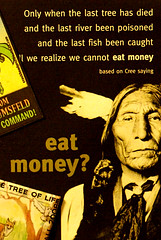
Eat Money?What we have now is not only immoral, but impending economic/ecological disaster on a large scale. The air, water and land upon which we depend are being polluted. The pollution is of a scale that is threatening - it is threatening our survival on a very real level.

So change is no longer only a moral imperative. It's not only a matter of ethical values. It's not only about kindness and reciprocity. It's about economic reality. It's about survival.

It's sad that it has come to this. People are dying. If humans are so smart, why isn't society set up to serve life - and to serve people? Why do we have a society that is designed to serve capital? Why are we slaves to capital. It's bogus. And the only reason it's like this is so that some few can have power over so many.

People, we need to stand up and learn to take back control of our governmental institutions. We need to take our government, our society, our community, our culture, our lives, our loves, and our families back, to take it back from the giant corporations.

It's not just about morality and doing what is right. It's about survival. I want to confront the tyranny in our society. To confront the tyranny that is killing people, killing eco-systems, killing plant and animal species. Lay it out bare.

This society is a killing society, this economy is a killing economy. This culture is laying waste to the resources of this planet. Mineral resources are being consumed at an astronomical rate. Will our gifts to future generations survive a legacy of profligacy and tyranny?

Woodard Bay Loop Trail Forest Panorama

The moral argument is strong. Society should never have gotten to this point - where people lie, and cheat, and steal from each other - where people abuse, and threaten, and beat up on, and kill each other. It shouldn't be this way. But now there is an economic imperative. There is the pressure of survival. There is the reality of pending energy shortages.

Something must be done.

A friend lent me a book I that I am interested in exploring in detail, it's called THE TRANSITION HANDBOOK: From oil dependency to local resilience, by Rob Hopkins, who is the Founder of the Transition movement.

I tend to think that the solution exists on the local level. So I probably already agree with most of what Hopkins has to say on this matter.

Well that's my socio/political/economic rant for the day.

A Theft from the People

To the U.S. Government and its keepers:
Stop stealing from the American People. Stop collecting tax monies to support a system that is harmful and destructive. Instead of spending money on war of aggression, on conquest, domination and imperialism—spend the money on projects which uplift humanity, spend the money on projects which are true to the service of life...

Stop spending money on death and destruction. Support projects that bring people closer toward one another. Support education, so people can better understand the world and each other, and become more tolerant and accepting.

Stop this thievery. Stop doing the bidding of a few powerful businesses and industries, and instead re-orient the system toward serving the best and common interests of all people in terms of the need for meaningful employment; healthy food, water and air; education; and a stable and truly sustainable economy.

Stop engaging in and enabling harmful economic activities.
(What is harmful? Let's have that discussion.)

[edit 2/25/09: Also in need of discussion is the necessity to invest in truly sustainable infrastructure - as opposed to simply aiming economic stimulus toward propping up this same old tired and broken, and iniquitous, system.

Additionally, the topic of education is of vital importance to addressing the need for knowledgeable, aware and capable individuals upon whom a great burden of reckoning will be placed in years to come.]

Power of Community

I already published this video on this blog, but it's worth posting again. It is about how the nation of Cuba survived a crisis similar to Peak Oil, in 1991, when imports from the Soviet Union ceased (upon collapse of the U.S.S.R..) The film explores how the Cuban people adjusted, specifically in terms of local economic solutions.

Many of the same solutions could be applied to societies elsewhere, if we were to make conscious changes, and a decision to move away from an economic infrastructure that is based on and utterly dependent on petroleum resources. Petroleum is a finite resource. It will run out. Whether it is in 30, 50, 100, or 300 years (or however long), there will come a time when we will not have access to petroleum.

What will fuel our economy and our every day lives? To what will we turn?

I argue that we would be better off to make these decisions, to make appropriate changes, without a (metaphorical) gun pointed toward our heads. Already, we are embroiled in wars over resources. Many people suffer and die because of domestic demand for petroleum. It's unethical to kill people over resources. The technology exists for an altruistic and enlightened society. Let us make changes that will benefit ourselves, and indeed all of humankind and future generations.


link to film on internet: http://www.livevideo.com/video/mercofspeech/CD893609A0CB495D9A9CF04AC9E4AEFF/power-of-community-how-cuba-.aspx

How Cuba Survived Peak Oil


I watched this movie for the first time tonight, and I recommend it highly. Well worth dragging all of your friends to see.

Read More: Oil and Sustainability and Cuba [OlyBlog].

Bacevich on Democracy Now

Andrew J. BacevichAndrew J. Bacevich appeared on last Friday's edition of Bill Moyers Journal. It was a great interview. He has recently written a book that explores and examines various aspects of US Foreign Policy - especially as it relates to cultural themes of consumerism and the American mentality of entitlement...

Today he appeared on with Amy Goodman on Democracy Now! check it out: The Limits of Power: Andrew Bacevich on the End of American Exceptionalism
Andrew Bacevich is a conservative historian who spent twenty-three years serving in the US Army. He also lost his son in Iraq last year. In a new book titled The Limits of Power: The End of American Exceptionalism, Bacevich argues that although many in this country are paying a heavy price for US domestic and foreign policy decisions, millions of Americans simply continue to shop, spend and satisfy their appetite for cheap oil, credit and the promise of freedom at home. Bacevich writes, “As the American appetite for freedom has grown, so too has our penchant for empire.” [includes rush transcript]
I urge you to check out the interview. It is so timely, relevant and really just important...

The Prize: The Epic Quest for Oil, Money and Power

This is an eight part series of videos produced by PBS/BBC based on Daniel Yergin's Pulitzer Prize winning nonfiction work, The Prize. Here are the eight episodes, as they have been published to Google Videos. I published a link to olyblog.net, where these videos have already been posted. But OlyBlog isn't working today, so I want to republish them here. Redundancy on the Internet... Here it is with descriptions as I found them attached to the videos posted on Google:
"In the style of the acclaimed CIVIL WAR series, THE PRIZE tells the epic history of oil - how it has dominated global politics, shaken the world economy, and transformed our century. Shot on location in Azerbaijan, Egypt, England, Indonesia, Japan, Kuwait, Mexico, Russia, Scotland, Turkey, and the United States, the series features fascinating characters, never-before-seen archival footage, newly filmed segments, and interviews with the people who shaped the oil industry. Yergin appears on camera throughout the series to discuss oil's impact on politics, economics, and the environment. We see how oil becomes the largest industry in the world--a game of huge risks and monumental rewards. Narrated by Donald Sutherland, THE PRIZE represents cinematic storytelling at its best - a historically significant tale of a quest for mastery that has revolutionized our civilization."
Part One

'Our Plan'
"Trace the turbulent, rapid rise of the world's biggest business, how a visionary but ruthless John D. Rockefeller controlled it--and how reporter Ida Tarbell took him on in one of the most famous muckraking exposes ever. A fascinating look at Rockefeller's controversial legacy, the rise of modern business, and how Tarbell served as the role model for the modern investigative journalist."
Part Two

Empires of Oil
"Witness capitalism on a grand scale: how Shell Oil and Royal Dutch merged, then challenged the supremacy of Rockefeller's Standard Oil. A compelling tale of how oil transformed everyday life in the farthest corners of the globe, made Russia a great oil power, and helped the Allies win World War I."
Part Three

The Black Giant
"It's the Roaring Twenties, and the magic of oil touches everyone, from millions of new car owners to hopeful Texan wildcatters. The American oil industry wrestles with shortage and surplus, as flamboyant entrepreneur Calouste Gulbenkian stakes his claim in Iraq."
Part Four

War and Oil
"The untold story of World War II unfolds: how oil dictated strategy to Hitler; how lack of oil slowed Japan's war machine; how oil ultimately determined victory or defeat. Features rare footage on the critical impact of oil on decisive military events."
Part five

Crude Diplomacy
"Post World War II America awakens to the strategic importance of oil and witnesses a key moment in history when oil production shifts from the US to the Middle East. An extraordinary cast of characters, including Arabian kings, US presidents, British adventurers, Iranian politicians, and American explorers paint a global portrait of how oil shaped the world economy and politics."
Part Six

Power to the Producers
"It's the heyday of cheap oil, the dawn of the Hydrocarbon Society...and the introduction of a prosperous new automobile culture for Americans. Follow the flamboyant characters, plots, and counterplots, as the producing countries and the independent oil companies challenge the "Seven Sisters"--and open a new era in world oil."
Part Seven

The Tinderbox
"Relive two decades of upheaval that shook the world as power shifted, and nations and companies jockeyed for position--amidst embargoes, shortages, and surpluses. A unique view of the rise of the OPEC era, beginning with the British withdrawal from the Persian Gulf and ending with the burning oil wells of Kuwait."
Part Eight

The New Order of Oil
"The Gulf War marked the beginning of a new era for the Hydrocarbon Society. This program explores the relationship between oil and the environmental conscience, and the technological race to balance energy, economic, and ecological needs in the Information Age."
Editorial Comment: I don't like some of the conclusions that are made in these videos, but I do think they are very valuable and effective in terms of presenting the massive impact that oil has had on society and the planet.

The Prize by Daniel Yergin

Check out the eight part video series, The Prize, based on the book of the same title by Daniel Yergin. I posted all eight episodes at olyblog.net. Here's the link: olyblog.net/understanding-each-other#comment-65309

Turse: Bush Administration Getting it Done on Iraq Oil

From TomDispatch.com:
Tomgram: Nick Turse, The Bush Administration Strikes Oil in Iraq

How Many Lives Per Gallon? …and speaking of oil, just when we were barely getting used to Big Oil and Iraq hitting the front pages of American newspapers in tandem, here comes Afghanistan! Who now remembers that delegation of Taliban officials, shepherded by Unocal ("We're an oil and gas company. We go where the oil and gas is…"), back in 1999, that made an all-expenses paid visit to the U.S. There was even that side trip to Mt. Rushmore, while the company (with U.S. encouragement) was negotiating a $1.9 billion pipeline that would bring Central Asian oil and natural gas through Afghanistan to Pakistan? Oh, an! d who was a special consultant to Unocal on the prospective deal? Zalmay Khalilzad, our present neocon ambassador to the U.N., George W. Bush's former viceroy of Kabul and then Baghdad, and a rumored future "Afghan" presidential candidate.

Those pipeline negotiations only broke down definitively in August 2001, one month before, well, you know… and, as Toronto's Globe and Mail columnist Lawrence Martin put it, "Washington was furious, leading to speculation it might take out the Taliban. After 9/11, the Taliban, with good reason, were removed -- and pipeline planning continued with the Karzai government. U.S. forces installed bases near Kandahar, where the pipeline was to run. A key motivation for the pipeline was to block a competing bid involving Iran, a charter member of the 'axis of evil.'"

Well, speak of the dead and not-quite-buried. It turns out that, in April, Turkmenistan, Afghanistan, Pakistan, and India (acronymically TAPI) signed a Gas Pipeline Framework Agreement to build a U.S.-backed $7.6 billion pipeline. It would, of course, bypass Iran and new energy giant Russia, carrying Turkmeni natural gas and oil to Pakistan and India. Construction would, theoretically, begin in 2010. Put the emphasis on "theoretically," because the pipeline is, once again, to run straight through Kandahar and so directly into the heartland of the Taliban insurgency.

Pepe Escobar of Asia Times caught the spirit of the moment perfectly: "The government of Afghan President Hamid Karzai, which cannot even provide security for a few streets in central Kabul, has engaged in Hollywood-style suspension of disbelief by assuring unsuspecting customers it will not only get rid of millions of land mines blocking TAPI's route, it will get rid of the Taliban themselves." Nonetheless, as in Iraq, American (and NATO) troops could one day be directly protecting (and dying for) the investments of Big Oil in a new version of the old imperial "Great Game" with a special modern emphasis on pipeline politics.

There has been a flurry of reportage on the revived pipeline plan in Canada, where -- bizarrely enough -- journalists and columnists actually worry about such ephemeral possibilities as Canadian troops spending the next half century protecting Turkmeni energy. If you happen to live in the U.S., though, you would really have no way of knowing about such developments, no less their backstory, unless you were wandering the foreign press online.

Nick Turse, author of the indispensable new book, The Complex: How the Military Invades Our Everyday Lives, considers the Iraq oil story that did, at last, hit the mainstream news here (only a few years late in the Great Game) and offers suggestions for mainstream reporters now ready to pursue the story wherever it leads, even back into an ignored, and oily, past. Tom

The Iraqi Oil Ministry's New Fave Five
All the Oil News That's Fit to Print (Attn: The New York Times)
By Nick Turse

Click here to read more of this dispatch.

Marine in Afghanistan to US Civilians: Do what you can to get us out of here

http://www.npr.org/templates/story/story.php?storyId=91881419

Here's a great segment, I was impressed by a statement from a Marine at about 4 minutes and 22 seconds into the program. The Marine says (I'm paraphrasing): My question is for the civilians. What are you doing? What are you doing to get us out of here?

Check it out for yourself.

Bush Administration Prewar Deception

Here are some excerpts from recent articles that support the claim that members of the Bush Administration knowingly and intentionally misled the people of the USA in regard to the threat posed by Iraq.

NYT:
WASHINGTON — A long-delayed Senate committee report endorsed by Democrats and some Republicans concluded that President Bush and his aides built the public case for war against Iraq by exaggerating available intelligence and by ignoring disagreements among spy agencies about Iraq’s weapons programs and Saddam Hussein’s links to Al Qaeda.
...
Washington Post:
As former White House press secretary Scott McClellan wrote in his recently released book, "What Happened," the Iraq Group "had been set up in the summer of 2002 to coordinate the marketing of the war to the public."

"The script had been finalized with great care over the summer," McClellan wrote, for a "campaign to convince Americans that war with Iraq was inevitable and necessary."
...
The Prosecution of George W. Bush for Murder (Promotional Video with author Vincent Bugliosi): Vincent Bugliosi lays out the case for prosecuting President Bush for murder, based on evidence that the President knowingly distorted the threat posed by Iraq in order to justify the invasion. Thousands of dead US military personnel and Hundreds of thousands of dead Iraqis later, the case for holding the President accountable for this grievous foreign policy disaster is very strong. No Blood for Oil!

Antonia Juhasz at Northwest Winter Soldier

Who are the winners in this war? Pull back the curtain!

In Support of Global Dominance

Our legislators don't represent the will of the people for peace and justice. Instead they all too often represent the will of corporations for global dominance, even to the point of militarism and the use of violence. Here's a comment I made at OlyBlog about Congressman Brian Baird (D - WA 3rd Congressional District):
go to original

Do the terms "liberal" or "conservative" have meaning anymore?

As far as it goes with the occupation of Iraq, Congressman Baird certainly provides liberal support to those (Western multi-national petroleum corporations) who seek domination and control over the oil resource of Iraq.

It's great that Baird is a strong proponent of abortion rights and other things. But I wish he was a support of peace, justice and disarmament. It seems that he is an able and willing supporter of global dominance and a foreign policy of violent militarism. Congressman Baird lives up to a the tradition of the military-industrial-congressional-complex.

The same criticism that applies to Baird also applies, unfortunately, to a majority of US Legislators: they are wedded to a system that represents the interests of the corporations. It's corporatism plain and simple. Regular citizens just don't have access to government anymore.

The people need healthcare and good, stable jobs. But the corporations are making it impossible - with the help of Congress.

If the work is to represent the interests of peace and justice, the government is often less than willing to receive the message. (This is also true at State and local levels, but the degree of receptivity varies on a case by case basis.)

27 Gallons of Fuel per Day per Soldier in Iraq

The US military is currently consuming over 27 gallons of fuel per day, per soldier, in Iraq:

go to original
Military feels fuel-cost gouge in Iraq

By ANNE FLAHERTY, Associated Press Writer
Thu Apr 3, 1:27 AM ET

Think you're being gouged by Big Oil? U.S. troops in Iraq are paying almost as much as Americans back home, despite burning fuel at staggering rates in a war to stabilize a country known for its oil reserves.

Military units pay an average of $3.23 a gallon for gasoline, diesel and jet fuel, some $88 a day per service member in Iraq, according to an Associated Press review and interviews with defense officials. A penny or two increase in the price of fuel can add millions of dollars to U.S. costs.

Critics in Congress are fuming. The U.S., they say, is getting suckered as the cost of the war exceeds half a trillion dollars — $10.3 billion a month, according to the Congressional Research Service.

Some lawmakers say oil-rich allies in the Middle East should be doing more to subsidize fuel costs because of the stake they have in a secure Iraq. Others point to Iraq's own burgeoning surplus as crude oil prices top $100 a barrel. Baghdad subsidies let Iraqis pay only about $1.36 a gallon.

The U.S. military, through its Defense Energy Support Center, buys fuel on the open market, paying from $1.99 a gallon to as much as $5.30 a gallon under contracts with private and government-owned oil companies. The center then sets a fixed rate for troops, currently $3.51 a gallon for diesel, $3.15 for gasoline, $3.04 for jet fuel and $13.61 for avgas, a high-octane fuel used mostly in unmanned aerial vehicles.

Kuwait does grant substantial subsidies, but they cover only about half the fuel used by the U.S. in Iraq. And the discount is eaten up by the Energy Support Center's administrative costs and fluctuations in the market.

Overall, the military consumes about 1.2 million barrels, or more than 50 million gallons of fuel, each month in Iraq at an average $127.68 a barrel. That works out to about $153 million a month.

Historically, these figures are astounding. In World War II, the average fuel consumption per soldier or Marine was about 1.67 gallons a day; in Iraq, it's 27.3 gallons, according to briefing slides prepared by a Pentagon task force established to review consumption.

The surge in demand can be attributed in part to the military's expanding aviation fleet, including helicopters, and its reliance on planes to shuttle cargo and troops between the U.S. and Iraq. Vehicles, too, are more heavily armored and require more energy to run. Another major contributor is the widespread use of generators to cool troops.

The Pentagon's demand for fuel in Iraq has had little if any effect on global oil prices. Frank Verrastro, director of the energy and national security program at the Center for Strategic and International Studies in Washington, said the military's use of 1.2 million barrels a month — or roughly 40,000 barrels a day — represents a small chunk of the 86 million barrels demanded each day on the global market.

Instead, Verrastro says, the hike in oil prices since the 2003 invasion is more likely due to a "fear factor."

"Prices rise when Iran saber-rattles, or there's a disruption potential in Nigeria," he said. An even larger driver of fuel costs is global demand, fed by robust economies in Asia and the lack of available alternative fuel sources, according to Verrastro.

Still, some lawmakers say the U.S. is paying too much to secure an oil-rich nation that resides in a neighborhood swimming in the natural resource.

Rep. Gene Taylor, D-Miss., a member of the House Armed Services Committee, said he was shocked last December to watch U.S. troops in Kuwait filling diesel tanks at higher prices than he would have paid to fill up his boat in Mississippi.

"The Kuwaitis have been good allies. But let's face it, that nation would not be there if not for the American liberation of Kuwait," he said, referring to the 1991 conflict.

When Taylor pressed Pentagon and embassy officials on the matter, he was told Kuwait was actually offering a rare discount. Unlike other oil-rich allies, Kuwait is estimated to have saved the U.S. government $1.2 billion in four years, from 2002 to 2006, U.S. Embassy officials told the congressman in a Jan. 3 letter.

Under the current agreement, the Kuwait-owned company supplies 7,000 gallons per day of free fuel to U.S. forces operating inside Kuwait. For troops in Iraq, Kuwait offers 860,000 gallons of jet fuel a day at less than half the market price. This discounted fuel represents more than half the fuel the U.S. uses in Iraq each day.

The rest of the fuel — about 100,000 to 200,000 gallons a day — is sold to the U.S. military at market rate.

When Taylor asked whether more could be done by Kuwait and other oil-rich allies in the Middle East, a senior Pentagon official said the U.S. wants to see an even bigger reduction in prices from Kuwait but indicated there was no guarantee that would happen.

"It is our view that all of those forces, whether they are semi-stationed in Kuwait ... or those transitioning into Iraq, should receive that fuel at a reduced rate, and that is continuing dialogue that goes on between our government and the government of Kuwait," Mark Kimmitt, deputy assistant secretary of defense for the Middle East, said in a January hearing.

It's unlikely the U.S. has pressed Saudi Arabia, Qatar or other oil-rich allies recently to help subsidize the cost of fuel in Iraq. The Defense Department referred questions about such negotiations to the State Department, where a spokesman said the agency was not aware of any.

Rep. Roscoe Bartlett, R-Md., also a member of the Armed Services Committee and a vocal advocate pushing the military to pursue alternative energy solutions, said he doubts such talks would be fruitful anyway because of the impression by many in the Middle East that the U.S. invaded Iraq for its oil to begin with.

"I'm not sure they're as convinced we're fighting for them, as they were in the first Gulf war," Bartlett said.

He said he hopes instead that the war will spur military development of hybrid technologies and alternative fuels at a time when private companies are lacking the financial incentive. So far, the price of oil hasn't restricted combat operations, but it has inspired the military to hunt for new ways to conserve energy.

Development of more energy-efficient equipment will take time. Former CIA Director James Woolsey, who co-chaired a policy panel on the Pentagon energy study, said operations in Iraq and elsewhere are forcing the military to take the burden of fuel costs more seriously.

"The combination of $100-a-barrel oil and the terrorist situation and the dependence on the Middle East are really, I think, waking them up very fast," he said.

In the meantime, other lawmakers say they want to see the high costs of the war defrayed by Iraq dipping into its own oil revenues, which are projected to be substantial. Independent auditors estimate that Iraq is headed this year toward a massive surplus because of as much as $60 billion in oil revenues — a consequence of increased production paired with the sharp rise in prices.

"It's totally unacceptable to me that we are spending tens of billions of dollars on rebuilding Iraq while they are putting tens of billions of dollars in banks around the world from oil revenues," said Sen. Carl Levin, D-Mich., chairman of the Armed Services Committee. "It doesn't compute as far as I'm concerned."

Administration and military officials say Baghdad hasn't been able to spend its oil revenues so far because the newly formed government is still learning how to manage its revenues. They say Iraq's lack of spending isn't due to corruption or laziness, but rather Baghdad's inability to determine where its money is needed most and how to allocate it efficiently.

The Iraqis have a "genuine mechanical problem in drawing up national budgets (and) executing those budgets, particularly when it comes to capital infrastructure," said David Satterfield, the State Department's senior adviser on Iraq. But, he added, the government is improving with time and should be able to do more in the months to come.

__

On the Net:

The Defense Science Board Task Force report: http://www.acq.osd.mil/dsb/reports/2008-02-ESTF.pdf

Responsible Withdrawal from Iraq

I viewed a film last night called "Baghdad: A Doctor's Story". It was part of the 5th Annual SESAME Film Festival. It was filmed by Dr. Omer Salih Mahdi. It was originally published by the BBC News program This World.

The filmmaker, Dr. Mahdi, was kind and generous enough to travel to Evergreen in order to comment and to answer questions. I was powerfully moved by the film. There were riveting images and sounds and scenes that showed the chaos that reigned in Baghdad at the time of filming (during the summer of 2006).

I was particularly struck by something the doctor said afterward. He said that he does not wish for the US Troops to withdraw from Iraq because of his fear that all out violence would erupt. It was hard for me to listen to him say that. I had so much opposition to the invasion and I have so much opposition to the war of occupation. I want the US Military to withdraw from Iraq. I certainly don't want violence to erupt. If withdrawal is truly stemming a flood of all out violence - then it will be hard to argue for withdrawal.

I still believe, however, that a gradual withdrawal will be possible without resulting in a flood of violence.

Most importantly though, the mission must change to one of stabilization and reconstruction. The US Military must make specific and intensive efforts to repair and reconstruct the civilian infrastructure of Iraq, thereby stabilizing civil society and improving economic conditions. What the Iraqi people need is stability. They need jobs and food and clean water.

Dr. Mahdi said that the Iraqi people don't have resentment toward the US Troops, which I find hard to believe.

Withdrawal must remain the goal. An indefinite imperial presence in Iraq would not behoove either nation. The doctor said that the US troops are the only neutral presence in Iraq. The US troops are neutral in terms of sectarian affiliation. The US troops are not neutral though. They are in Iraq as an occupying force. The US Military occupies Iraq in order to secure the oil wealth. It may sound ridiculous, but the oil is necessary for global domination, which is a goal of the American elite decision makers.

The war is illegal; it's about oil.

The war is illegal. It is illegal because it is an aggressive military action, and aggressive military actions are illegal, period. Members of the Bush Administration lied - numerous false statements have repeatedly been made - in order to justify an invasion that was based on the notion of "preemptive strike" (Center for Public Integrity War Card Report). They claimed a specific threat from Iraq to the security of the USA. But the reality was that Iraq did not pose an imminent or specific threat to the USA. Iraq certainly did not pose a threat that would have justified military intervention.

Essentially, the use of the phrase "preemptive strike" does not alter the fact that the invasion - the "strike" - was an aggressive maneuver. "The facts were being fixed to meet the policy" - so famously said the director of British Intelligence, Sir Richard Dearlove, in a memo (The Downing Street Memos) to the office of Tony blair, the Prime Minister of the UK.

So, the war is illegal. It was an attack. It was motivated not by desire for true security; it was motivated by desire for "global dominance." "Global Domination" is a Project for a New American Century key phrase for imperialism. There is a desire to project the power of the USA over a broad spectrum of economic and military channels. But American Empire cannot flourish without petroleum. Reliable access to consistent flows of crude oil are necessary to support the economic functions of the American Empire. Hence, the invasion and occupation of Iraq.

Over one million Iraqis are said to have died as a result of the "war." The war is illegal; it's about oil.

Bombings Kill Dozens in Iraq

Questions:

What is the USA doing in Iraq? Did Iraq pose a threat to the USA prior to the invasion? Were there Weapons of Mass Destruction? Why do millions of Iraqis suffer, their civilian infrastructure so widely reduced to ruin? Is it because of the petroleum resource? Were these deaths necessary? Were they preventable? If the occupation is unjust - if it is wrongful - what can you and I do to stop it?
Two Bombings Kill At Least 26 in N. Iraq
Officials Call for Increase in Security Forces
By Joshua Partlow
Washington Post Foreign Service
Wednesday, December 26, 2007; A14

BAGHDAD, Dec. 25 -- Two bombs ripped through a pair of cities north of Baghdad on Tuesday, causing some of the worst carnage in the country in recent weeks and revealing that, despite the relative calm that has taken hold, insurgent groups remain capable of carrying out devastating attacks.

The morning bombs were detonated in Baiji, an oil refinery town, and Baqubah, a provincial capital where the Sunni insurgent group al-Qaeda in Iraq has lost some of its earlier dominance. The attacks, which killed at least 26 people and wounded as many as 100, prompted calls by officials for an increase in Iraqi soldiers and police in the northern provinces to quell the violence.

In Baqubah, tensions were particularly high because of allegations by Iraqis that, hours before the bombing there, U.S. forces had executed two members of an American-backed volunteer force. The U.S. military denied the accusations.

The bombing in Baiji, near a checkpoint outside a two-story housing complex for oil industry employees, was the more devastating of the two attacks Tuesday...
go to original

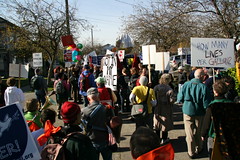
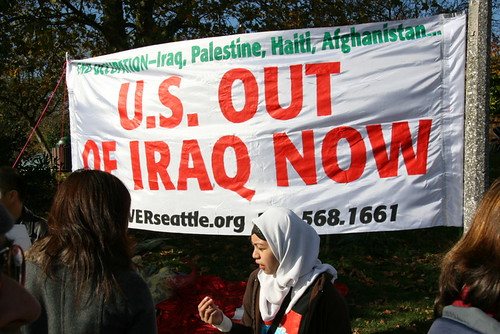
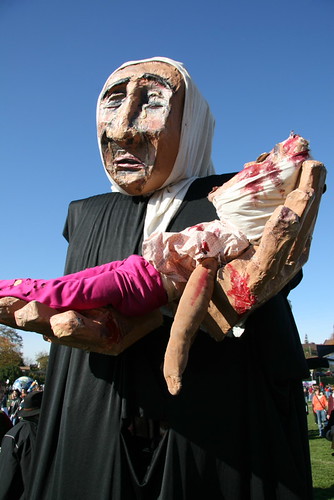
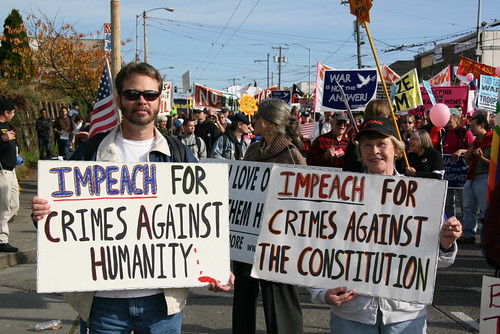
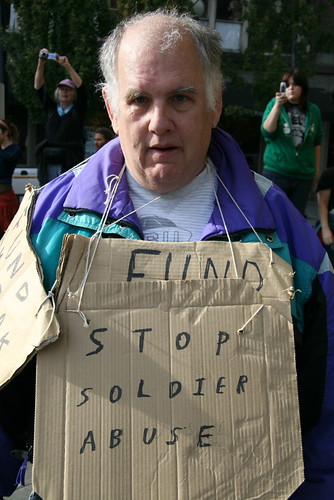
Seattle Protest Against the "War" October 2007

I went to the UFPJ rally and march in Seattle this past weekend. It was a great event. The numbers weren't as great as I would have liked them to be, but the people who showed up were passionate and genuine in their desire for peace and for the creation of a better society and a better world. There was a caravan from Olympia, I am not sure about the specific numbers. The Olympian quoted 200. Here's a link to the Olympian article, which includes a couple of choice quotes from me as well as a picture of me. Diane Huber did a decent job reporting on the Olympia Caravan. But I wish she would have fleshed out more of my conversation with her in the article. I talked with her for a while. It was a good conversation. She seemed genuinely interested and possibly even sympathetic with the anti-occupation cause... What I wish that she would have included in the article were my thoughts about the necessity of impeachment. Impeachment (of certain prominent Executive Branch officials) for any malfeasance that has occurred during the Bush Administration is vital to the healthy and wholesome future of the USA - as well as to the creation of a stable social environment in Iraq.

Secondly, an unjust and belligerent military occupation of another country is unacceptable. It is time to begin a safe and responsible withdrawal of all military personnel from Iraq.

Here's a sample of some of the photos I took from Saturday. You can find more here (flickr) and here (dotmac):

October 2007 Seattle Protest - U.S. Out of Iraq

Mourn Iraqi Deaths

Impeach!

Stop Soldier Abuse

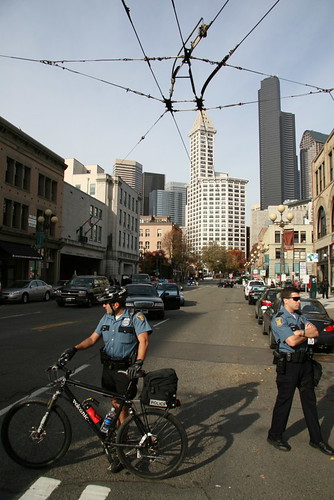
Downtown Seattle

Jack Miles on Iraq: Faulty Occupation

I want to plug this well-written article, by Jack Miles, on the deteriorating political situation in Iraq. Support our troops by bringing them home. The occupation of Iraq by the American Military is unwelcome and unjust.
Endgame for Iraqi Oil?
The Sovereignty Showdown in Iraq
By Jack Miles

The oil game in Iraq may be almost up. On September 29th, like a landlord serving notice, the government of Iraq announced that the next annual renewal of the United Nations Security Council mandate for a multinational force in Iraq -- the only legal basis for a continuation of the American occupation -- will be the last. That was, it seems, the first shoe to fall. The second may be an announcement terminating the little-noticed, but crucial companion Security Council mandate governing the disposition of Iraq's oil revenues.

By December 31, 2008, according to Foreign Minister Hoshyar Zebari, the government of Iraq intends to have replaced the existing mandate for a multinational security force with a conventional bilateral security agreement with the United States, an agreement of the sort that Washington has with Kuwait, Saudi Arabia, and several other countries in the Middle East. The Security Council has always paired the annual renewal of its mandate for the multinational force with the renewal of a second mandate for the management of Iraqi oil revenues. This happens through the "Development Fund for Iraq," a kind of escrow account set up by the occupying powers after the overthrow of the Saddam Hussein regime and recognized in 2003 by U.N. Security Council Resolution 1483. The oil game will be up if and when Iraq announces that this mandate, too, will be terminated at a date certain in favor of resource-development agreements that -- like the envisioned security agreement -- match those of other states in the region.

The game will be up because, as Antonia Juhasz pointed out last March in a New York Times op-ed, "Whose Oil Is It, Anyway?":
"Iraq's neighbors Iran, Kuwait and Saudi Arabia…. have outlawed foreign control over oil development. They all hire international oil companies as contractors to provide specific services as needed, for a limited duration, and without giving the foreign company any direct interest in the oil produced."
By contrast, the oil legislation now pending in the Iraqi parliament awards foreign oil companies coveted, long-term, 20-35 year contracts of just the sort that neighboring oil-producers have rejected for decades. It also places the Iraqi oil industry under the control of an appointed body that would include representatives of international oil companies as full voting members.

The news that the duly elected government of Iraq is exercising its limited sovereignty to set a date for termination of the American occupation radically undercuts all discussion in Congress or by American presidential candidates of how soon the U.S. occupation of Iraq may "safely" end.
...
[keep reading!]

No End in Sight: Movie Review

I just returned from the Capitol Theatre in Olympia (WA) where I viewed the documentary film, No End in Sight.

It was an emotional experience, gripping, and I am stunned. This film is a must see. This goes especially for elected officials, representatives, and other governmental/military personnel. This film casts a revealing view of the situation regarding the buildup to the invasion of Iraq as well as some of the intricacies of the occupation. It pays special attention to the early occupation, and L. Paul Bremer's administration of the CPA.

This film includes first person testimony and perspective from a variety of officials who were intimately involved in the invasion and occupation.

Again, this film is a must see. If I was a dictator, I would command that you view this film, under penalty of the revocation of your citizenship. But since I am not a dictator (nor do I care to be one,) I will simply plead with you, please, please, pretty please see this film. You owe it to yourself as a human, and you owe it to humanity.

One of the most stunning aspects of the film was the attention it devoted to the early occupation failure that was the neglect paid to looting. Virtually every Iraqi Governmental Ministry (except the Oil Ministry - because it was the only one granted protection from US Military) was looted in the month that followed the invasion.

The looting was severe and set a drastic and harmful precedent of lawlessness. It created an environment where violence came to reign supreme. Weapons caches full of rifles and ammunition and explosive ordnance were not least amongst the long list of items that were looted from public institutions as well as private business and homes.

One thing that the movie didn't answer, and it spent a lot of time exploring, was exactly why Bremer made the decision to disband the Iraqi Military. When the military of Iraq was let go, it created about one half million (500,000) soldiers who were armed and suddenly unemployed. This lent to a perfect environment for an insurgency.

Did Bremer and the Bush Admin. want an insurgency? Why did Bremer make so many (apparent) mistakes in the early occupation?

This movie is a must see. Please. Do me the favor of seeing this one for yourself.
 
Aldo Leopold: "We abuse land because we regard it as a commodity belonging to us. When we see land as a community to which we belong, we may begin to use it with love and respect."

keywords: peace, justice, truth, love, wisdom, common sense, ethics, nonviolence, compassion, communication, community, egalitarian, equitable, society, culture, future, politics, government, public interest, sustainability, economy, ecology, nature, beauty, urban issues, environment, wilderness, energy, industry, reciprocity, karma, dignity, honor, patience, life, photography, music, flowers, and more!