Showing posts with label global hegemony. Show all posts

A Social Transformation Toward Sustainability and Justice Would Benefit Everyone

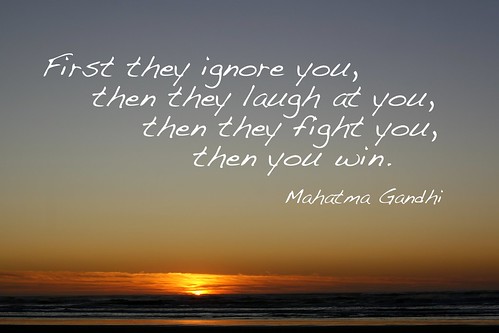
First they ignore you, then they laugh at you, then they fight you, then you win.
the words of Mahatma (Mohandas K.) Gandhi

This quote needs to be framed in reference to the struggle by people native to the Indian Subcontinent against what was the tyrannous and incredibly violent and harmful colonialism that was waged under the auspices of the British Empire.

I also like the idea of altering the quote slightly so that it ends with "everyone wins" - because real social transformation toward justice and sustainability would benefit everyone. Real social transformation, justice and sustainability would prove to be a winner for everyone...

Wow!!! Humanity has done such a huge damage to itself and to the living systems of the Earth in such a short time since the advent of fossil fueled industrialization!

The following are thoughts which are cross-posted at OlyBlog, link below:

I would really like to see people from the various social and environmental justice movements working along more of a unified front.

The root causes of environmental degradation and ecological unsustainability; imperialism and wars of aggression; exploitative labor practices; societal oppression; and poverty and any other social injustice are the same.

I would like to see a broad based, inclusive and supportive social movement - a movement that is accessible to everyone regardless of age, gender, race, ethnicity, religion, ability, creed, and/or any other distinguishing feature - in order to effectively and successfully challenge the status quo: a status quo which is currently doing so much harm to all people.

Please imagine a movement to challenge the current establishment's enablement of a degrading and dehumanizing status quo of economic instability, ecological unsustainability, and social injustice...

Further thoughts and avenues for consideration on this topic include, but are not limited to, potential solutions and responses such as 1) permaculture: a resilient, sustainable and independent local/regional economic infrastructure, 2) socio-economic egalitarianism, 3) making health care a central and foundational economic feature ...and etc....

larger image olyblog.net/working-union
Military Evil

Viewer be advised: This is very graphic and highly disturbing material.

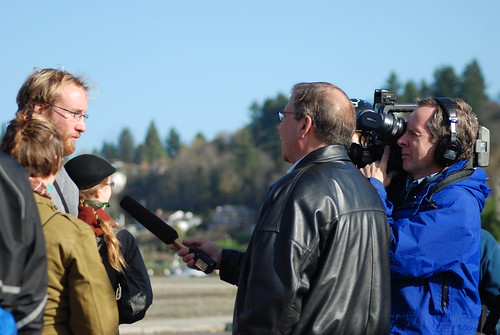
Antiwar Protest Interview

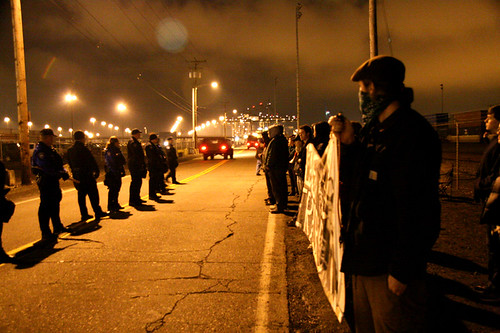
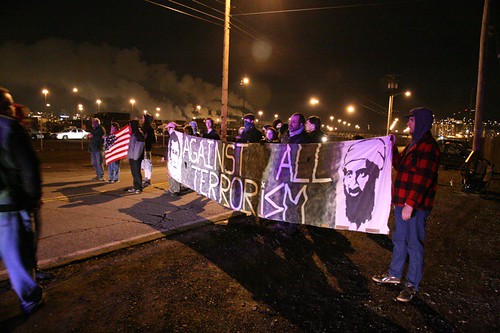
Speaking to Reporters at the November 2007 Olympia Port Protests
Olympia, Washington
November 2007
Photo by Kay Schultz

Here I am talking to news reporters about the way police attacked peaceful protesters with chemical weapons, and also the anti-war/anti-imperialism civil resistance movement's need for legal support.

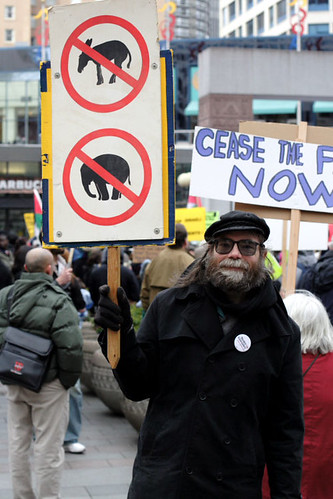
No Donkey! No Elephant!

No Donkey and No Elephant
No Donkey, No Elephant

"No" to bi-partisan support for U.S. international policies.

Policies of dominance and aggression, and exploitation of overseas material and labor resources are wrong - these policies are harmful and violent!

If the U.S.A. wants to counteract "extremist" opposition - then the people of the U.S. will need to take a look at the extremely abusive economic policies that have their roots in U.S. policies and practices.

No to Abusive Economic Policies!

View Larger: No Donkey, No Elephant

Cremation of Care

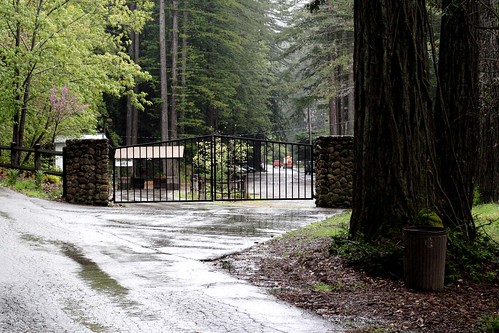
Bohemian Grove EntranceOne of the biggest stories that I followed in 2009 was about the Bohemian Grove and the Cremation of Care. In early June of 2009, Lindsey Baum, an eleven year old child from McCleary, Washington went missing (and was possibly abducted.) McCleary is near Olympia and the story received a lot of attention. For some reason, the abduction of this child struck me, and made me think of the Cremation of Care ceremony that occurs at the annual midsummer Bohemian Grove encampment. In the ceremony, the effigy of a child named Dull Care gets cremated.

Alex Jones claims to have infiltrated the grove and the ceremony, and to have made the following video of the ceremony - which is shocking and highly disturbing.

I believe that to care is a virtue, and oughtn't be thought of as onerous or burdensome. And as you can see from the video of the ceremony, it is obvious that some of the members of the Bohemian Grove may think differently - maybe even going so far as to think of care as an obstacle to the workings of the marketplace.

An attitude of disdain for care - amongst some of the world's most powerful, and influential, men of business and government - an attitude of disdain for the important necessary moral place of care in our society is, I believe, a tremendous driver of social and environmental violence (ranging from child abductions and other domestic violence, to industrial pollution, global warming, and the extinction of species, to the structural roots of the world's problem of one billion chronically hungry human beings, to war and the military-congressional-industrial complex, and the multitudinous various oppressions and injustices that exist in between...)

I don't know about the authenticity of this video - but it seems to be genuine. I don't know how Alex Jones could have possibly infiltrated the Grove - he even claims to have been stopped numerous times by security, meanwhile the secret camera he has in a bag just happens to be out of tape at the time. I think it's possible that the Jones video was done with some sort of consent (very much unlike Alex Shoumatoff's visit.) And I certainly do not necessarily agree with Alex Jones on everything, including some of the comments made in the video (some of which sounded quite racist, homophobic, and anti-pagan (just because the Bohos do some pagan ritual doesn't mean that all paganism is corrupt and/or evil!)) But the ceremony is interesting to see, and you can judge for yourself.

Your truth will set you free.

So check it out, and see/decide for yourself.

And I should add a warning - this video is quite shocking and disturbing.

Here's what I think is the full length video, though I can't be sure. The CC Ceremony starts about 1 hour and 17 minutes into the video:


The following video is a smaller excerpt from the above. I recommend watching the above.


http://www.blogger.com/video-play.mp4?contentId=5ebf0bd11a8549b5&type=video%2Fmp4

Here's an embed of the same video:

http://video.google.com/videoplay?docid=5617720002953136903

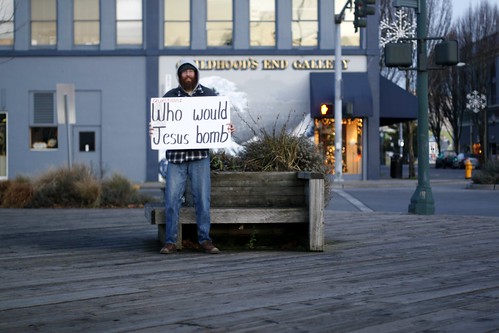
Who Would Jesus Bomb

Who Would Jesus Bomb
Who would Jesus bomb?

Christmas Day, 2009

Olympia Fellowship of Reconciliation Peace Vigil

Percival Landing, Olympia, Washington

War is immoral. All war begins with aggression. Aggression is immoral. Military aggression is widely considered immoral, and there are numerous international legally binding treaties established against war of aggression. It is probably unanimous amongst international political bodies that aggression is immoral and illegal. How could it not be? If stealing is illegal, if rape is illegal, if murder is illegal - then how could the most horrendous violence possible - the violence of a war of aggression - ever be considered legal.

Self-defense is one thing. A reasonable and proportional self-defense against immediate attack. But the wars of the United States of America are a different beast. The wars of the USA are not truly self-defense - nor a legitimate protection of "national interest." What the wars of the USA defend is the selfishness and the greed of the USA. The wars are an effort to further international policies of and practices of oppression and exploitation, under which the USA operates. The wars of the USA do not truly defend the national interest. The wars and international policies of the USA defend the corporate interest - the interest of the most influential and powerful (typically multi-national) giant corporations.

War is immoral. For good reason. War is the worst violence known to humanity. War is waste. It is oblivion. War is destruction defined.

People and nations have a right to defend themselves. But people and nations do not have a right - and in fact they betray the rights of all people - when they commit the crime of a war of aggression.

The wars of the USA are aggressive wars - imperialistic wars - wars designed to further the establishment of dominance - of global hegemony.

I believe that the imperialism of the USA, and the giant corporations that are its keepers, is the worst violence known to modern humanity.

But this perspective - these truths - are very effectively kept away from the American people by a revolving door between cultural affectation, and a media structure that feed off of, and create, each other.

There is a horrible myth in today's America, and to a lesser extent in today's world. It is the myth that America is the greatest nation on Earth - when in reality, the very opposite may be true. It may be more true that America is the worst nation on Earth - that America is the world's greatest perpetrator of violence and oppression - even to the point of wars of aggression, conquest and imperialism.

In America, terrible violence is part of mainstream culture. In America, there is a disparity in wealth between rich and poor that is maintained through systematic oppression.

In America, some people make profit when bombs are dropped. People profit when wars are waged. People profit from all sorts of harmful, destructive and violent economic (and anti-economic) activities!

So, really, I ask you to please answer this question: who would Jesus bomb?

Obama Peace Prize Protest


Obama didn't mention the obvious common sense reality - that it is American policies of militaristic violence, imperialism and economic exploitation that are the principle underlying causes of anti-American terrorism...

It's wrong to use violence against people. It's wrong to profit from harmful activities.

Very disappointing. The empire rages on.

War is a Racket, by Smedley Butler

Please take some time to watch this important video. It's a theatrical rendering of a speech delivered by Major General Smedley D. Butler, USMC, to the National VFW, in 1933:

War is a Racket by Smedley Butler

Care is "Dull" at the Bohemian Grove: Global Dominance, Economic Exploitation, and Social Violence

I left the following comment on The Olympian.com. I believe that the problems of social violence, economic exploitation, and environmental degradation are connected with policies like global dominance, which is a political concept espoused by many of the most powerful men in the world, some of whom meet at the Bohemian Grove (near Monte Rio, CA), for a Summer Encampment - where they celebrate the "Cremation of Care." Here's a link to a story about the case of Lindsey Baum. Lindsey is a missing child, who disappeared more than four months ago. I believe the problem of missing children is interrelated with other problems of society. Link to the story with my comment: After four months, authorities have little evidence in Lindsey Baum case

And here's the comment I made:
I am of the opinion that the problem of missing children is directly related to the societal ethics of putting profit before people. Lindsey Baum went missing about a month before the annual Bohemian Grove Summer Encampment. At the encampment, some of the world's most powerful businessmen and political decision makers partake in a ceremony called The Cremation of Care, which involves the ritual cremation of "Dull Care" - the effigy of a sacrificed child. I believe this attitude - that care is dull - on the part of the world's most powerful men is directly related to societal violence, and domestic abuses, including but certainly not limited to child disappearances and abductions.


[more information:] Missing Children, Global Dominance, The Bohemian Grove, and The Cremation of Care
Entrance to Bohemian Grove

The White House, the Pentagon, and War (etc.)

The following is a comment (slightly amended for clarity) that I just posted to the White House Facebook Page. I was inspired by a Nick Turse article from Tomdispatch.com, Tomgram: Nick Turse, In Afghanistan, the Pentagon Digs in.
To President Obama and Administration:

I believe that war is an outmoded and archaic way to deal with dispute. The USA has a serious problem in its relationship with the world - because our government seems to be content to enable a corporatist policy of global dominance. Under the policy of global dominance, some few act as though they are entitled to receive state support for their efforts to "take without asking" (of material and other resources) - and to exert political and economic influence on sovereign peoples/nations/lands.

That's imperialism. It hurts people. It's very sad.

I strongly believe that a "hands off" approach is a far better way to approach international relationships. No coercive pressure. No economic exploitation. The disparity in wealth between rich and poor is astronomical - and I strongly believe that the massive riches of some is all too often NOT based purely on merit.

The extreme wealth of a very small class of people is based more purely on single-minded (and unregulated) ambition. The extreme wealth is based on a willingness to dominate others and "put others down" (including the natural environment.) The tremendous treasure of those few is based in economically exploitative behaviors that, when all is said and done, serve only an individual's economic interest. Some people's wealth comes at the expense of the well-being of others. It's an arrangement that is very far from copacetic.

Please stop the torturing and the bombing. It's a horrible disservice to humanity.

We can choose to go in the direction of truth, love, hope and justice. Or we can continue this horrible decay of war and environmental abuses. We have a choice. Please, President Obama and Administration, use your voice. Lead America toward the right choice. Lead away from violence, fear, and hate. Lead toward kindness, love, truth, justice and peace. Show us that you are not profiteers by clamping down on these tremendously harmful behaviors.

In Afghanistan - there is no military solution short of total destruction, and that is not a solution at all. So there is no military solution. Many people of Afghanistan hate the Taliban. But many of them have come to hate America even more. American soldiers have been told that the way to win the war is to make people fear them more than anyone else. To rule by fear. It's not the way to make friends - nor is it the way to peace.

Does the USA want peace, or does the USA want domination? It's a serious question. The only rational interpretation is that the USA wants domination. The USA can't have it both ways. It's either domination or peace. They don't go hand in hand.

Please choose the path of peace. Please show us the caring spirit that exists in the hearts of all human beings. Please demonstrate your concern for the well-being of all people.

The situation is serious. The planet's ecological systems are in crisis. We need to confront the problem of perpetual economic growth and come to understand that it is antithetical to sustainability. Instead of growth dependent markets, we would do well to transition to a steady state economy.

Thank you.
[I also wrote another one yesterday, viewable at this link: Letter to the President, as Posted on Facebook]

Global Dominance, The Cremation of Care, The Bohemian Grove, and Missing Children

Beginning to connect the problem of missing children to policies of global dominance, the Bohemian Grove, and the Cremation of Care Ceremony:
olyblog.net/missing-children-global-dominance-bohemian-grove-and-cremation-care

Bohemian Grove Summer Encampment with the Cremation of "Dull Care"

Bohemian Grove Entrance

Every Summer, about 2,500 of some of the world's richest and most powerful men gather at the Bohemian Grove. During the encampment's opening ceremony, a ritual sacrifice is performed. It's called the "Cremation of Care." In the initiation, the effigy of a human child named "Dull Care" is ritually sacrificed, and then cremated.

Rumors abound that in times past the ritual involved the sacrifice of a real actual living human child. I don't know if that's true or not. But whether or not that's actually the case, this ceremony is disturbing on many different levels. Two ways in which it is disturbing are: one, the basic idea of human sacrifice, and two, the notion of wanting to do away with care (via cremation.)

Ritual human sacrifice, and cremating care - that is the effigy of a child named "Dull Care": this seems strange to me. What's behind it? - I wonder.

Personally, I think it is wrong. The idea of some of the world's most powerful men gathering, performing ritual human sacrifice, and celebrating the concept of doing away with care: it's just wrong.

Care is a virtue. Care is a form of love - not something to be lightly or gaily discarded. Children are not to be sacrificed. They are to be protected, to be cared for, to be treated with love, understanding, respect, and kindness - to be taught about the magic of life, and the deep and sacred majesty of the planet, and their fellow humankind.

So Please - Don't sacrifice people (even for pretend.) And don't cremate care!

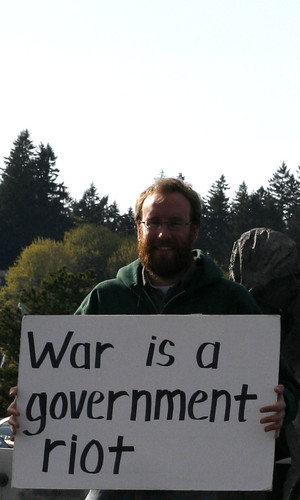
War is a Government Riot

The government uses war as a supposed solution to conflict. But war is really unnecessary. Our own government engages in offensive wars of conquest (AKA: Aggression), cloaking it as "necessary defense" against terrorism. But it's not necessary. And to boot, it was policies and politics (and specific practices) of (and related to) conquest (AKA domination and/or imperialism), which have created the environment and the will for terrorists and terrorism to develop.

War is a Government Riot

On the Right Side of the Law

Martin Luther King Jr.Laws, and rules, exist to protect people, and planet. If rules do not protect people, then of what good are they - of what use?

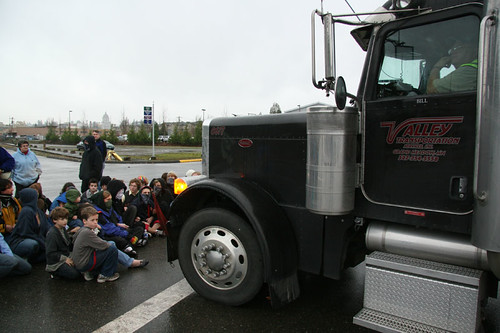
Protesters who oppose the use of public roadways and municipal transportation facilities, for enablement of movement of military hardware that is destined for the cause of imperialistic and interventionist wars, are on the right side of the law - even to the point when they act in direct action, civil resistance (necessarily nonviolent,) to the military traffic.

Mass nonviolent civil resistance is a promising avenue of direct action for stopping the imperialism of the government of the USA. Real policy changes must occur. The current corruption is much too costly.

(In part, to the people of law enforcement agencies:) Get on the right side of the law. Oppose imperialism and aggression!

Nonviolent Blockade
Nonviolent Strike Against War!

Bohemian Grove

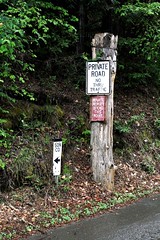
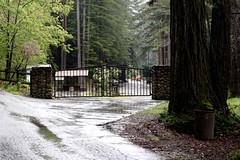
While travelling recently in California, I had the opportunity to stop by the Bohemian Grove. It's a place I have long been curious about. It was an uninvited visit, so I wasn't able to enter the private property of the Grove. But just seeing the entrance was quite an experience in itself.

The Bohemian Club hosts an annual summertime encampment at the Grove. It's an event where a couple thousand or so of some of the world's most powerful men gather to supposedly, and among other things, banish their cares about the world. This banishment of care is exemplified in the encampment yearly initiation ceremony, which is descriptively titled the "Cremation of Care." In the ceremony, the effigy of a young child named "Dull Care" is sacrificed and cremated upon an altar.

Here are some photos from the entrance, and more of my thoughts about the "cremation of care."

Bohemian Grove Entrance

Caring is a virtue. To care ought NOT to be thought of as onerous or burdensome.

We are all of one human family.

We are, each of us, complete, within and of, our own selves.

That's truth.

There is also truth in power. But it is not a full or complete truth. The full truth, a holistic truth, takes into account the effects of our actions on others. When another, or others, are hurt by my activities (or even perhaps lack thereof,) whether the activities be personal, recreational, professional and/or business, then a balance has been broken - a harmony disrupted. We are all one human family, and no one is left undamaged when we hurt one another. No one is left unscathed. Not the aggressor (or oppressor), nor, certainly, the target (of oppression - or any type of hurt.)

Human beings are to be respected. Not exploited. Not commodified. Not treated as a market for the peddling of wares. Human beings are sacred, and very worthy of being cared for.

Humans are here on Earth to be stewards, gardners, protectors - guiding perhaps, and improving, and beautifying - but not ruling. I believe that humans are not meant to rule over each other, nor to rule over the Earth.

Here's a link to an article by Alex Shoumatoff published in the May 2009 Vanity Fair magazine: www.vanityfair.com/style/features/2009/05/bohemian-grove200905

More information about the Bohemian Grove from Wikipedia: en.wikipedia.org/wiki/Bohemian_Grove

More photos:

Bohemian Grove Timber Harvest Paperwork
Bohemian Grove "Timber Harvest" Paperwork

Bohemian Grove County Line

Entrance to Bohemian Grove

Communicating and Maintaining Sacred Space in an Age of State Terrorism

I like this article by Starhawk. It deals with the problems of violence and state terrorism in the "antiglobalization" movement.

Personally, I support globalization - but only of ideas. I am opposed to economic globalization on the basis that it is dominated by valueless - amoral - "corporations", or big businesses, which are wedded only to the bottom line of financial and material profit without a true understanding or affinity to quality of life for people, and ecological stability (sustainability.)

The current globalization is destroying the Earth - a business that none of us can afford to be in.
Asking the right questions by Starhawk

Genoa was a watershed for the antiglobalization movement. It's clear now that this is a life or death struggle in the first world as it has always been in the third world. How we respond will determine whether repression destroys us or strengthens us. To come back stronger, we have to understand what actually happened there.

The media are telling one story about Genoa: a small group of violent protestors got out of hand and the police overreacted. I've heard variations on this from within the movement: the Black Bloc was allowed to get out of hand to justify police violence. But that's not what happened in Genoa, and framing the problem that way will keep us focused on the wrong questions.

Let's be clear: In Genoa we encountered a carefully orchestrated political campaign of state terrorism. The campaign included disinformation, the use of infiltrators and provocateurs, collusion with avowed Fascist groups (and I don't mean fascist in the loose way the left sometimes uses the term, I mean Fascist as in 'direct inheritors of the traditions of Mussolini and Hitler'), the deliberate targeting of nonviolent groups for tear gas and beating, endemic police brutality, the torture of prisoners, the political persecution of the organizers, and a terrorist night raid on sleeping people by special forces wearing "Polizia" T-shirts under black sweatshirts, who broke bones, smashed teeth, and bashed in the skulls of nonresisting protestors. They did all this openly, in a way that indicates they had no fear of repercussions and expected political protection from the highest sources. That expectation implicates not only the proto-Fascist Berlusconi regime of Italy, but by association the rest of the G8, especially the U.S. since it now appears that L.A. County Sheriffs helped trained the most brutal of the special forces.

Italy has a history of the employment of such tactics, going back to the 'strategy of tension' used against the left in the nineteen seventies, in fact, even further back to the 'twenties and 'thirties which don't seem all that far away any more once you've heard prisoners describe being tortured in rooms with pictures of Mussolini on the walls. Maybe even back to the Renaissance, if not the ancient Romans. The same tactics have, of course, been used extensively by U.S. agencies and other countries. Italy also has a political culture of highly confrontational actions and streetfighting with the police, as well as strong pacifist groups and groups like the Tute Biancha who are exploring new political territory that goes beyond the traditional definitions of violence and nonviolence. All of this set the stage upon which the events of the G8 protest were played.

The police used the Black Bloc, or more accurately, the myth and image of the Black bloc, very effectively in Genoa, for their ends, not ours. Some aspects of Black Bloc tactics made that easy: the anonymity, the masks and easily identifiable dress code, the willingness to engage in more confrontational tactics and in property damage, and perhaps most significant, the lack of connection with the rest of the action and the organizers.

But the Black Bloc was not the source of the problem in Genoa. The problem was state, police and Fascist violence. Acts were done in Genoa, attributed to protestors, that were irresponsible and wrong by anyone's standards-but it seems likely now that most of them were done by police. Or if not, police provocateurs were so endemic that it's impossible to tell what might have been done by people in our movement or to hold anyone accountable. So the issue Genoa presents us with is not "How do we control the violent elements among us?", although that conceivably might be an issue someday. It's "How do we forestall another campaign of lies, police-instigated violence, and retaliation?"

There's no easy answer to that question. The simplest strategy would be to go back to a strict form of nonviolence, which many people are proposing. I don't know why I find myself in resistance to that answer. I'm a longtime advocate of nonviolence, I have no intention of ever throwing a brick through a window or lobbing a rock at a cop myself, and in general I think breaking windows and fighting cops in a mass action is counterproductive at best and suicidal at worst.

One reason might be that I can no longer use the same word to describe what I've seen even the most unruly elements of our movement do in actions and what the cops did in Genoa. If breaking windows and fighting back when the cops attack is 'violence', then give me a new word, a word a thousand times stronger, to use when the cops are beating nonresisting people into comas.

Another might be just that I like the Black Bloc. I've been in many actions now where the Black Bloc was a strong presence. In Seattle I was royally pissed off at them for what I saw as their unilateral decision to violate agreements everyone else accepted. In Washington in 2000, I saw that they abided by guidelines they disagreed with and had no part in making, and I respected them for it. I've sat under the hooves of the police horses with some of them when we stopped a sweep of a crowded street using tactics Gandhi himself could not have criticized. I've choked with them in the tear gas in Quebec City and seen them refrain from property damage there when confronted by local people. I'm bonded. Yes, there have been times I've been furious with some of them, but they're my comrades and allies in this struggle and I don't want to see them excluded or demonized. We need them, or something like them. We need room in the movement for rage, for impatience, for militant fervor, for an attitude that says "We are badass, kickass folks and we will tear this system down." If we cut that off, we devitalize ourselves.

We also need the Gandhian pacifists. We need room for compassion, for faith, for an attitude that says, "My hands will do the works of mercy and not the works of war." We need those who refuse to engage in violence because they do not want to live in a violent world. And we need space for those of us who are trying to explore forms of struggle that fall outside the categories. We need radical creativity, space to experiment, to carve out new territory, invent new tactics, make mistakes.

There are campaigns being waged now that are defined as clearly and strictly nonviolent: the School of the Americas, Vandenberg, Vieques, among others. Those guidelines have been respected, and no black clad brick throwing figures have attempted to impose other tactics. But the actions directed against the big summits have drawn their strength from a much broader political spectrum, from unions and NGOs to anarchist revolutionaries. All these groups feel a certain ownership of the issue and the fat, juicy targets that the summits represent.

How do we create a political space that can hold these contradictions, and still survive the intense repression directed against us? How do we go where no social movement has ever gone before?

Maybe these are the questions we really need to ask. In a life or death situation, there's a great temptation to attempt to exert more control, to set rules, to police each other, to retreat to what seems like safe ground. But all my instincts tell me that going back to what seems safe and tried and true is a mistake. As an anarchist, I'm not interested in doing any kind of police work. I want to call each other to greater, not lesser freedom, knowing that also means greater responsibility and greater risk.

Using provocateurs to instigate violence which can be blamed on dissenters and used to justify repression is a time tested, generally successful way of destroying radical movements. But it's a strategy that thrives on the familiar, the expected. Identifying provocateurs in the midst of an action is like trying to spray for a pest in the garden: the toxicity of the spray, of the suspicion, secrecy and lack of trust, may be as great as that of the pest.

But plants can resist pests if they are grown in healthy soil. To forestall infiltration and provocateurs, we need to examine the soil of our movement. I'd like to suggest three nutrients that can make us more pest resistant: communication, solidarity and creativity.

We have to be in communication. We can no longer afford to wage parallel but disconnected struggles at the same demonstration. We need to clearly state our intentions and goals for each action, and ask others to support them. We may need to argue and struggle with each, to negotiate, to compromise. Articulating a clear set of agreements about tactics may at times be the best way to forestall provocateurs. But agreements are only agreements when everyone participates in making them. If one wing of the movement attempts to impose them, they are not agreements but decrees, and moreovoer, decrees that will not be respected and that we have no power to enforce.

That communication involves risk on both sides, but those risks have to be taken, intelligently and thoughtfully, of course. We need to put a higher priority on our communication than on our standing with our funding sources or our security culture. If my tactic of choice makes it impossible for me to talk to you, I need to question whether it's an appropriate tactic for a mass action.

In that dialogue, we actually have to struggle to respect each other. No one gets to claim the moral high ground. None of us get to exclusively set the agenda, determine the form of what we do or decree the politics. Those who advocate nonviolence, a chief tenet of which is to respect your opponent, need to practice it within the movement. You can't just dismiss the Black Bloc and other militant groups as 'negative rebels' or immature adolescents acting out. They have a political perspective that is serious, thoughtful, and deserves to be taken seriously.

But it also means that more militant groups need to stop dismissing those who advocate nonviolence as middle-class, passive, and cowardly. The Black Bloc is widely respected for its courage, but it takes another kind of courage to sit down in front of the riot cops without sticks or rocks or Molotovs. It takes courage to have your identity known, to organize in your own city where you can't disappear but must stand and face the consequences. 'Nonviolent' does not equate with 'nonconfrontational', or with wanting to be safe on the sidelines. The essence of nonviolent political struggle is to create intense confrontations that highlight the violence in the system, and then to stand and openly take the consequences. In today's repressive climate, where 88 year old nuns are being given year long prison sentences for completely pacific actions, the risks of nonviolence may be much higher than the risks of anonymous street fighting.

We need to communicate clearly with the larger community as well, proactively, not reactively. We have to let people know what our intentions are and what the parameters of the action might be. Imagine the Black bloc putting out a Crimestopper Leaflet: "If you see a group of masked figures looting small shops, burning private cars, and endangering your children, get their badge numbers! They are the Cops! Because we're the Black Bloc, and that's not what we do!" We need to talk to the not-already-converted, door to door, face to face, not to lecture them but to ask about their lives and the effects these issues have on them, and to ask them to show support for us.

We need to be in real solidarity with each other. Solidarity is not just about refraining from denouncing each other to the media, or holding vigils for those in jail. It means putting the good of the whole above our immediate individual desires or even safety. It means supporting each other's intentions and goals, even when we only partially agree with them. Not just by saying, "you do your thing and I'll do mine," but by actually taking responsibility for our actions and for the impact they have on others beyond ourselves or our immediate group. Greater freedom demands greater responsibility.

In a mass action individual decisions have a collective impact. Some tactics are like the loud-voiced guy in the meeting: they take up all the available space and make it impossible for anyone else to be heard. Cops are not creatures of fine distinctions. If one group is throwing Molotov cocktails and smashing shop windows, it may well affect how the police react to the pacifist group a block over. The community, too, may miss the subtle difference between burning the neighborhood bank and burning the neighborhood store. So, just as the loud guy has to learn to step back occasionally and shut up to give others a chance to be heard, high confrontation tactics sometimes need to be restrained just to allow other possibilities to exist.

Solidarity is about what we do on the street. It means protecting each other as best we can, and certainly not deliberately endangering each other. Of course, one group's idea of protection may be another group's idea of endangerment. A barricade may seem protective, but if your strategy is to deescalate tension, a barricade may actually make your situation more dangerous. We need to respect each other's choices. Solidarity means that if I'm sitting down in front of a line of riot cops and you're behind me, I can trust that you're restraining the crowd behind from trampling me, not throwing a rock over my head. And that if you push through a line of cops and I'm behind you, I'm there to support you, not restrain you. We have a right to ask for solidarity from everyone who wants to be out on the street together.

Solidarity is also about holding each other accountable, critiquing what we do together with the purpose of learning from our mistakes and becoming more effective. Critiquing is not attacking: a good critique is a mark of respect, it's saying, "I know that you and I share a common interest in making this work better."

Perhaps most of all, we need to be creative. Maybe, just to stimulate our thinking, we need to mount one action with one simple guideline: No tired, overused tactics allowed. No cross-the-line symbolic arrests, no bricks through the windows of Starbucks. And please, please, no boring chants that have been recycled since the Vietnam War, if not before. ("Hey hey, ho ho, King George the Third has got to go?") At least this would be a useful thought experiment.

We need to think outside the fences and the boxes. We need to do the unexpected, change clothes, change tactics, be where they don't expect us to be, doing what they don't expect us to do. If they expect us to trash McDonalds, we're there disrupting its operations by giving out free food and asking the workers how globalization affects them. If they expect militants to dress in black, then the militants go lavender and the pacifists stage a Funeral for Democracy, surrounding the White House dressed in black mourning and veils. If they expect us to walk up quietly in groups of five to get arrested, we disappear and reappear somewhere else entirely. If the hardcore streetfighters pull down a fence, the 88 year old nuns are the first through into the red zone. If they block off the meeting and concentrate their defenses on a wall, we claim the rest of the city. If they hide the summits in inaccessible locations, we choose our own turf.

These are hard challenges, but these are hard times, too and they're not getting easier. I've already seen too many movements splinter and fail or grandstand themselves to death in ever more extreme and suicidal acts, or suffocate from self-righteous moralism. I want to win this revolution. I don't think we have the ecological and social leeway to mount another one if this fails. And the odds of winning are so slim that we can't afford to be anything but smart, strategic, and tight with one another. We need to stand shoulder to shoulder, even when we disagree. And if we can do that, if we can hold these differences within our movement, we'll have taken a step toward meeting the much greater challenges we'll face when we do win, and come to remake a deeply diverse world.
(Thanks to Lisa Fithian, Hilary McQuie ad David Miller for discussions that contributed to this piece.)

© 2001 Starhawk

Starhawk is a well-known author and magical activist. You can visit her web page at:

www.starhawk.org

HOME

War in Afghanistan

Afghanistan is famous for its violent conflicts. The region has been fought over for hundreds of years.

The US war in Afghanistan has been taken for granted. The war started only a few days after the 9/11/2001 WTC attacks. People by and large did not question the Bush Administration's decision to launch an invasion and campaign of sustained occupation of Afghanistan.

But the premise and concept of the occupation of Afghanistan is worthy of taking a closer look. For example, terrorists, from a group which is supposedly headquarted in Afghanistan, attacked the World Trade Center in New York City. Does this give the USA the right to invade and occupy the whole of Afghanistan? The answer is no. The terrorist attacks do not give the USA the right to intervene in the affairs of a sovereign national government, except to the point of seeking, and rooting out, suspected terrorists.

The events of 9/11/2001, and the war in Afghanistan, give us the opportunity to explore the foreign policies of our nation in terms of blowback.

Many people around the world, including myself, are critical of the imperialism of the USA. Terrorists are motivated by the harmfulness of economic exploitation and oppression, which stems from the policies and practices of the USA.

The way to truly make the USA safe and secure, is to operate in the world in ways that are respectful, tolerant of personal differences between peoples and nations, and fair and just.

Bullying and belligerence, economic exploitation and oppression, will only serve to provoke anti-American sentiment, and possibly even terrorist attacks.

Six Year War Anniversary Protest


March 2009, Iraq War Sixth Anniversary Protest

Six years of war in Iraq. The imperialistic set of foreign affairs are unacceptable.

What is Necessary for Legitimate Self-Defense

I had a conversation earlier today about the military force of the United States of America, and I made the assertion that the USA could provide for its legitimate self-defense needs with about 10% of the current military spending.

What do you think about the legitimate self-defense needs of the USA? I am not talking about defending imperialism. Just regular old basic self-defense. What's reasonable?

My understanding is that military, and military related, spending by the federal government is now up over the $1T mark (that is one trillion dollars: $1,000,000,000,000 (yes, that is 12 zeros.))

I wonder if the USA could provide for its legitimate needs for self-defense on a far slimmer budget. Yes, I think it could. Sounds like a good idea to me. By spending less on military - 9/10 of which (I postulate) is unnecessary and unrelated to legitimate self-defense - more money would be available to promote lasting and sustainable economic endeavors, broadening opportunity, and prosperity for all.

As far as imperialism goes, imperialism is actually anathema to national security - it's a destabilizing economic influence. With imperialism, although some may (perhaps) benefit — a great many others suffer, their well-beings (collective and individual) jeopardized and harmed.
 
Aldo Leopold: "We abuse land because we regard it as a commodity belonging to us. When we see land as a community to which we belong, we may begin to use it with love and respect."

keywords: peace, justice, truth, love, wisdom, common sense, ethics, nonviolence, compassion, communication, community, egalitarian, equitable, society, culture, future, politics, government, public interest, sustainability, economy, ecology, nature, beauty, urban issues, environment, wilderness, energy, industry, reciprocity, karma, dignity, honor, patience, life, photography, music, flowers, and more!