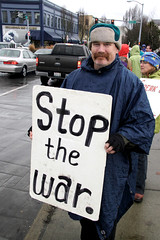
Showing posts with label civil resistance. Show all posts

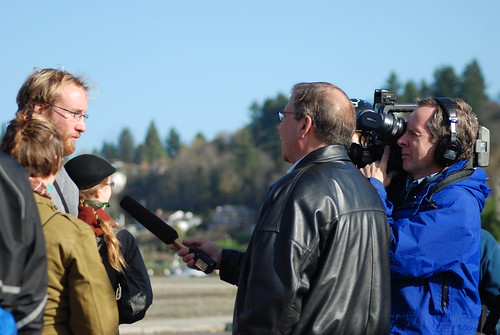
Antiwar Protest Interview

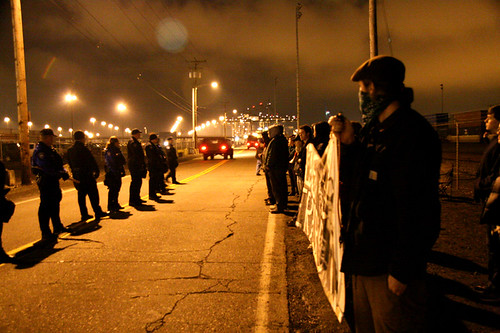
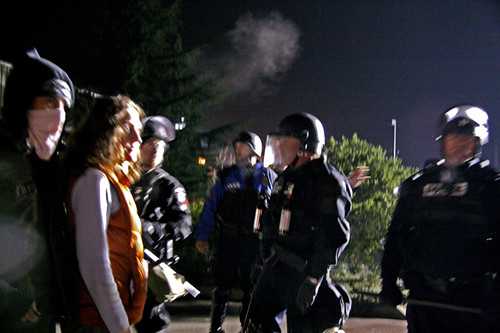
Speaking to Reporters at the November 2007 Olympia Port Protests
Olympia, Washington
November 2007
Photo by Kay Schultz

Here I am talking to news reporters about the way police attacked peaceful protesters with chemical weapons, and also the anti-war/anti-imperialism civil resistance movement's need for legal support.

Communicating and Maintaining Sacred Space in an Age of State Terrorism

I like this article by Starhawk. It deals with the problems of violence and state terrorism in the "antiglobalization" movement.

Personally, I support globalization - but only of ideas. I am opposed to economic globalization on the basis that it is dominated by valueless - amoral - "corporations", or big businesses, which are wedded only to the bottom line of financial and material profit without a true understanding or affinity to quality of life for people, and ecological stability (sustainability.)

The current globalization is destroying the Earth - a business that none of us can afford to be in.
Asking the right questions by Starhawk

Genoa was a watershed for the antiglobalization movement. It's clear now that this is a life or death struggle in the first world as it has always been in the third world. How we respond will determine whether repression destroys us or strengthens us. To come back stronger, we have to understand what actually happened there.

The media are telling one story about Genoa: a small group of violent protestors got out of hand and the police overreacted. I've heard variations on this from within the movement: the Black Bloc was allowed to get out of hand to justify police violence. But that's not what happened in Genoa, and framing the problem that way will keep us focused on the wrong questions.

Let's be clear: In Genoa we encountered a carefully orchestrated political campaign of state terrorism. The campaign included disinformation, the use of infiltrators and provocateurs, collusion with avowed Fascist groups (and I don't mean fascist in the loose way the left sometimes uses the term, I mean Fascist as in 'direct inheritors of the traditions of Mussolini and Hitler'), the deliberate targeting of nonviolent groups for tear gas and beating, endemic police brutality, the torture of prisoners, the political persecution of the organizers, and a terrorist night raid on sleeping people by special forces wearing "Polizia" T-shirts under black sweatshirts, who broke bones, smashed teeth, and bashed in the skulls of nonresisting protestors. They did all this openly, in a way that indicates they had no fear of repercussions and expected political protection from the highest sources. That expectation implicates not only the proto-Fascist Berlusconi regime of Italy, but by association the rest of the G8, especially the U.S. since it now appears that L.A. County Sheriffs helped trained the most brutal of the special forces.

Italy has a history of the employment of such tactics, going back to the 'strategy of tension' used against the left in the nineteen seventies, in fact, even further back to the 'twenties and 'thirties which don't seem all that far away any more once you've heard prisoners describe being tortured in rooms with pictures of Mussolini on the walls. Maybe even back to the Renaissance, if not the ancient Romans. The same tactics have, of course, been used extensively by U.S. agencies and other countries. Italy also has a political culture of highly confrontational actions and streetfighting with the police, as well as strong pacifist groups and groups like the Tute Biancha who are exploring new political territory that goes beyond the traditional definitions of violence and nonviolence. All of this set the stage upon which the events of the G8 protest were played.

The police used the Black Bloc, or more accurately, the myth and image of the Black bloc, very effectively in Genoa, for their ends, not ours. Some aspects of Black Bloc tactics made that easy: the anonymity, the masks and easily identifiable dress code, the willingness to engage in more confrontational tactics and in property damage, and perhaps most significant, the lack of connection with the rest of the action and the organizers.

But the Black Bloc was not the source of the problem in Genoa. The problem was state, police and Fascist violence. Acts were done in Genoa, attributed to protestors, that were irresponsible and wrong by anyone's standards-but it seems likely now that most of them were done by police. Or if not, police provocateurs were so endemic that it's impossible to tell what might have been done by people in our movement or to hold anyone accountable. So the issue Genoa presents us with is not "How do we control the violent elements among us?", although that conceivably might be an issue someday. It's "How do we forestall another campaign of lies, police-instigated violence, and retaliation?"

There's no easy answer to that question. The simplest strategy would be to go back to a strict form of nonviolence, which many people are proposing. I don't know why I find myself in resistance to that answer. I'm a longtime advocate of nonviolence, I have no intention of ever throwing a brick through a window or lobbing a rock at a cop myself, and in general I think breaking windows and fighting cops in a mass action is counterproductive at best and suicidal at worst.

One reason might be that I can no longer use the same word to describe what I've seen even the most unruly elements of our movement do in actions and what the cops did in Genoa. If breaking windows and fighting back when the cops attack is 'violence', then give me a new word, a word a thousand times stronger, to use when the cops are beating nonresisting people into comas.

Another might be just that I like the Black Bloc. I've been in many actions now where the Black Bloc was a strong presence. In Seattle I was royally pissed off at them for what I saw as their unilateral decision to violate agreements everyone else accepted. In Washington in 2000, I saw that they abided by guidelines they disagreed with and had no part in making, and I respected them for it. I've sat under the hooves of the police horses with some of them when we stopped a sweep of a crowded street using tactics Gandhi himself could not have criticized. I've choked with them in the tear gas in Quebec City and seen them refrain from property damage there when confronted by local people. I'm bonded. Yes, there have been times I've been furious with some of them, but they're my comrades and allies in this struggle and I don't want to see them excluded or demonized. We need them, or something like them. We need room in the movement for rage, for impatience, for militant fervor, for an attitude that says "We are badass, kickass folks and we will tear this system down." If we cut that off, we devitalize ourselves.

We also need the Gandhian pacifists. We need room for compassion, for faith, for an attitude that says, "My hands will do the works of mercy and not the works of war." We need those who refuse to engage in violence because they do not want to live in a violent world. And we need space for those of us who are trying to explore forms of struggle that fall outside the categories. We need radical creativity, space to experiment, to carve out new territory, invent new tactics, make mistakes.

There are campaigns being waged now that are defined as clearly and strictly nonviolent: the School of the Americas, Vandenberg, Vieques, among others. Those guidelines have been respected, and no black clad brick throwing figures have attempted to impose other tactics. But the actions directed against the big summits have drawn their strength from a much broader political spectrum, from unions and NGOs to anarchist revolutionaries. All these groups feel a certain ownership of the issue and the fat, juicy targets that the summits represent.

How do we create a political space that can hold these contradictions, and still survive the intense repression directed against us? How do we go where no social movement has ever gone before?

Maybe these are the questions we really need to ask. In a life or death situation, there's a great temptation to attempt to exert more control, to set rules, to police each other, to retreat to what seems like safe ground. But all my instincts tell me that going back to what seems safe and tried and true is a mistake. As an anarchist, I'm not interested in doing any kind of police work. I want to call each other to greater, not lesser freedom, knowing that also means greater responsibility and greater risk.

Using provocateurs to instigate violence which can be blamed on dissenters and used to justify repression is a time tested, generally successful way of destroying radical movements. But it's a strategy that thrives on the familiar, the expected. Identifying provocateurs in the midst of an action is like trying to spray for a pest in the garden: the toxicity of the spray, of the suspicion, secrecy and lack of trust, may be as great as that of the pest.

But plants can resist pests if they are grown in healthy soil. To forestall infiltration and provocateurs, we need to examine the soil of our movement. I'd like to suggest three nutrients that can make us more pest resistant: communication, solidarity and creativity.

We have to be in communication. We can no longer afford to wage parallel but disconnected struggles at the same demonstration. We need to clearly state our intentions and goals for each action, and ask others to support them. We may need to argue and struggle with each, to negotiate, to compromise. Articulating a clear set of agreements about tactics may at times be the best way to forestall provocateurs. But agreements are only agreements when everyone participates in making them. If one wing of the movement attempts to impose them, they are not agreements but decrees, and moreovoer, decrees that will not be respected and that we have no power to enforce.

That communication involves risk on both sides, but those risks have to be taken, intelligently and thoughtfully, of course. We need to put a higher priority on our communication than on our standing with our funding sources or our security culture. If my tactic of choice makes it impossible for me to talk to you, I need to question whether it's an appropriate tactic for a mass action.

In that dialogue, we actually have to struggle to respect each other. No one gets to claim the moral high ground. None of us get to exclusively set the agenda, determine the form of what we do or decree the politics. Those who advocate nonviolence, a chief tenet of which is to respect your opponent, need to practice it within the movement. You can't just dismiss the Black Bloc and other militant groups as 'negative rebels' or immature adolescents acting out. They have a political perspective that is serious, thoughtful, and deserves to be taken seriously.

But it also means that more militant groups need to stop dismissing those who advocate nonviolence as middle-class, passive, and cowardly. The Black Bloc is widely respected for its courage, but it takes another kind of courage to sit down in front of the riot cops without sticks or rocks or Molotovs. It takes courage to have your identity known, to organize in your own city where you can't disappear but must stand and face the consequences. 'Nonviolent' does not equate with 'nonconfrontational', or with wanting to be safe on the sidelines. The essence of nonviolent political struggle is to create intense confrontations that highlight the violence in the system, and then to stand and openly take the consequences. In today's repressive climate, where 88 year old nuns are being given year long prison sentences for completely pacific actions, the risks of nonviolence may be much higher than the risks of anonymous street fighting.

We need to communicate clearly with the larger community as well, proactively, not reactively. We have to let people know what our intentions are and what the parameters of the action might be. Imagine the Black bloc putting out a Crimestopper Leaflet: "If you see a group of masked figures looting small shops, burning private cars, and endangering your children, get their badge numbers! They are the Cops! Because we're the Black Bloc, and that's not what we do!" We need to talk to the not-already-converted, door to door, face to face, not to lecture them but to ask about their lives and the effects these issues have on them, and to ask them to show support for us.

We need to be in real solidarity with each other. Solidarity is not just about refraining from denouncing each other to the media, or holding vigils for those in jail. It means putting the good of the whole above our immediate individual desires or even safety. It means supporting each other's intentions and goals, even when we only partially agree with them. Not just by saying, "you do your thing and I'll do mine," but by actually taking responsibility for our actions and for the impact they have on others beyond ourselves or our immediate group. Greater freedom demands greater responsibility.

In a mass action individual decisions have a collective impact. Some tactics are like the loud-voiced guy in the meeting: they take up all the available space and make it impossible for anyone else to be heard. Cops are not creatures of fine distinctions. If one group is throwing Molotov cocktails and smashing shop windows, it may well affect how the police react to the pacifist group a block over. The community, too, may miss the subtle difference between burning the neighborhood bank and burning the neighborhood store. So, just as the loud guy has to learn to step back occasionally and shut up to give others a chance to be heard, high confrontation tactics sometimes need to be restrained just to allow other possibilities to exist.

Solidarity is about what we do on the street. It means protecting each other as best we can, and certainly not deliberately endangering each other. Of course, one group's idea of protection may be another group's idea of endangerment. A barricade may seem protective, but if your strategy is to deescalate tension, a barricade may actually make your situation more dangerous. We need to respect each other's choices. Solidarity means that if I'm sitting down in front of a line of riot cops and you're behind me, I can trust that you're restraining the crowd behind from trampling me, not throwing a rock over my head. And that if you push through a line of cops and I'm behind you, I'm there to support you, not restrain you. We have a right to ask for solidarity from everyone who wants to be out on the street together.

Solidarity is also about holding each other accountable, critiquing what we do together with the purpose of learning from our mistakes and becoming more effective. Critiquing is not attacking: a good critique is a mark of respect, it's saying, "I know that you and I share a common interest in making this work better."

Perhaps most of all, we need to be creative. Maybe, just to stimulate our thinking, we need to mount one action with one simple guideline: No tired, overused tactics allowed. No cross-the-line symbolic arrests, no bricks through the windows of Starbucks. And please, please, no boring chants that have been recycled since the Vietnam War, if not before. ("Hey hey, ho ho, King George the Third has got to go?") At least this would be a useful thought experiment.

We need to think outside the fences and the boxes. We need to do the unexpected, change clothes, change tactics, be where they don't expect us to be, doing what they don't expect us to do. If they expect us to trash McDonalds, we're there disrupting its operations by giving out free food and asking the workers how globalization affects them. If they expect militants to dress in black, then the militants go lavender and the pacifists stage a Funeral for Democracy, surrounding the White House dressed in black mourning and veils. If they expect us to walk up quietly in groups of five to get arrested, we disappear and reappear somewhere else entirely. If the hardcore streetfighters pull down a fence, the 88 year old nuns are the first through into the red zone. If they block off the meeting and concentrate their defenses on a wall, we claim the rest of the city. If they hide the summits in inaccessible locations, we choose our own turf.

These are hard challenges, but these are hard times, too and they're not getting easier. I've already seen too many movements splinter and fail or grandstand themselves to death in ever more extreme and suicidal acts, or suffocate from self-righteous moralism. I want to win this revolution. I don't think we have the ecological and social leeway to mount another one if this fails. And the odds of winning are so slim that we can't afford to be anything but smart, strategic, and tight with one another. We need to stand shoulder to shoulder, even when we disagree. And if we can do that, if we can hold these differences within our movement, we'll have taken a step toward meeting the much greater challenges we'll face when we do win, and come to remake a deeply diverse world.
(Thanks to Lisa Fithian, Hilary McQuie ad David Miller for discussions that contributed to this piece.)

© 2001 Starhawk

Starhawk is a well-known author and magical activist. You can visit her web page at:

www.starhawk.org

HOME

Frederick Douglass on the Necessity of Struggle for Progress

I like this Frederick Douglass quote because it is in line with my belief about the need for an inclusive broadbased nonviolent civil resistance movement.
If there is no struggle there is no progress. Those who profess to favor freedom, and yet depreciate agitation, are men who want crops without plowing up the ground. They want rain without thunder and lightning. They want the ocean without the awful roar of its many waters. This struggle may be a moral one; or it may be a physical one; or it may be both moral and physical; but it must be a struggle. Power concedes nothing without demand. It never did and it never will.
[update:

Thinking more about this quote, I am curious about examples where powers that be may have made concessions without demand. Are there any examples of this? What kind of demands and concessions? Were they meaningful and substantial - or superficial?

I am also interested in asking about the nature of demand. Because I believe that demands can actually be nonviolent in nature. Even the making of demands can be uplifting, and can be in the service of all life. Demands, I argue, can even be relayed in a way that is joyful.

I believe that the struggle must be both moral and physical - I believe that it must also be nonviolent, honest and truthful - truly in service of life, and uplifting. It's difficult because there is so much innate anger and hostility that drive those who are most prone to protest.

I don't believe that hate is a natural condition. Hate is a disease and a cultural phenomenon. A lot of the time, people who feel hate, and who demonstrate hateful behavior, seem to not recognize it - or to not understand that it is hate, in and of itself, that is key to enabling the violences of oppression, tyranny, and imperialism.]

Support Women's Resistance to War

I support the Oly 26, a group comprised mostly of women who are being persecuted for their resistance, in November of 2007, to the ongoing illegal occupation of Iraq.

Civil Resistance - Nonviolent Direct Action

Words

Some words. You can consider it a poem if you would like to... Word - Word them up:
calm

joyful

peaceful

resolute

dignified
It's a work in progress. But I just wanted to get it down. To be utterly revealing, the topic is branding for the movement for peace and justice and nonviolence (and resistance to: the corruption and tyrannies of power, and the (destructiveness to the planet, to ecosystems, to societies and individuals - of the) violent corporatist crusade for dominance.) It is to establish a mental banner, a frame of sorts, for those who are engaged in the struggle. I am struggling to create a better world, a sane and sustainable society that respects and serves humanity, all life, and the Earth.

please join me

[Of course, the movement would need to consent to such a (mental - or spiritual) banner...]
updated 14:17 Saturday, August 30th, 2008

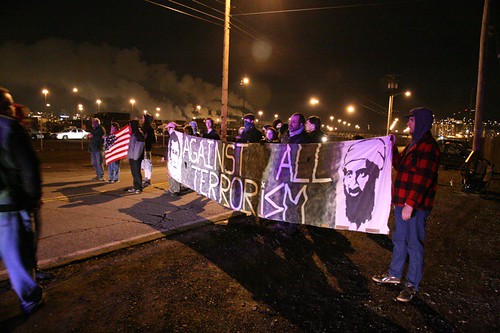
Back from Protesting Illegal War at the Port of Tacoma

I just got back from the Port of Tacoma. I went to protest the shipment of a military cargo that was destined to further the occupation of Iraq by my government of the USA. Why would I protest? Lots of reasons, but there are a few, really just one or two, that stand out most prominently. The main reason that I protest is that the war is illegal. Of course, if you have been following my position on the war, you'll realize that this is nothing new. If you have been following my position on the war then hopefully you will understand the basic foundations of my assessment of the war's illegality. Yes, it is simply because the President (George W. Bush) lied to me (and to you) about the nature of the threat posed by the state of Iraq (Iraq didn't pose a threat).

Okay. So I am aggravated by the protest, and the Port of Tacoma's and Tacoma Police Department's willingness to enable an act of aggression by the federal government. Tacoma is enabling the needless slaughter and sacrifice of American soldiers and innocent Iraqis. It's disgusting - hideous - obscene, I could go on...

It was an interesting night altogether, and less so in terms of interactions with the police than for interactions I had with fellow protesters, some of them "black bloc." I had some interesting discussions about the role of the black bloc and how some of the black bloc people see themselves and their role in promoting social change (if those are the right terms - they might not be; it is late and I am tired.) Hopefully I will have more to write, and feel like doing so, about the details of the night's events. I took a few pictures that might turn out too. so stay tuned

ANYWAY, after discovering that the quick release on my rear bicycle wheel had been loosened and the brake cable released, I rode safely home through a beautiful night under a somewhat (Olympia is a moderate sized urban area) thick blanket of stars.

Ahhh... the beauty of the stars!

Chiroux Refuses to Deploy to Iraq

A month ago, Matthis Chiroux bravely announced his courageous intention to refuse deployment in a war which he believes to be illegal. His unit deployed today, without him. Chiroux is an Army reporter, and says he has heard enough stories of what has gone on in Iraq to know that the occupation is immoral and illegal.
US soldier refuses to report for active duty in Iraq

WASHINGTON (AFP) — A month after US army reservist Matthis Chiroux publicly refused to deploy to Iraq, the former sergeant on Sunday set himself up for possible prosecution by failing to report for active duty with his unit in South Carolina.

"Tonight at midnight, I may face further action from the army for refusing to reactivate to participate in the Iraq occupation," Chiroux told reporters in Washington.

"I stand here today in defense of those who have been stripped of their voices in this occupation, the warriors of this nation...", Chiroux read from a statement as his father Rob, who had travelled to Washington from Alabama to support his son on Father's Day, stood beside him.

...
I'm not sure if this link will be permanent: http://afp.google.com/article/ALeqM5jlR6Ky_n9NjGaMqzy4Ks9bk-PThw

Also hear Matthis Chiroux interviewed on antiwar radio by Scott Horton: http://antiwar.com/radio/2008/06/04/matthis-chiroux/:

Scott Horton Interviews Matthis Chiroux

June 4th, 2008

Sgt. Matthis Chiroux discusses his refusal to redeploy to Iraq because of the illegality of the invasion, his role as an Army propagandist, how the Iraq Veterans Against the War helped him realize he wasn’t alone in opposing the illegal occupation and the widespread and neglected PTSD suffered by so many vets.

MP3 here. (35:26)

Sgt. Matthis Chiroux, who served in the Army until being honorably discharged last summer after over four years of service in Afghanistan, Japan, Europe and the Phillipines, today publicly announced his intention to refuse orders to deploy to Iraq. Sgt. Chiroux made his announcement in the Cannon House Office Building Rotunda after members of Iraq Veterans Against the War testified before the Congressional Progressive Caucus during Winter Soldier on the Hill.

Here's a link to another interview at Courage to Resist: http://www.couragetoresist.org/x/content/view/595/1/

Winter Soldier Northwest

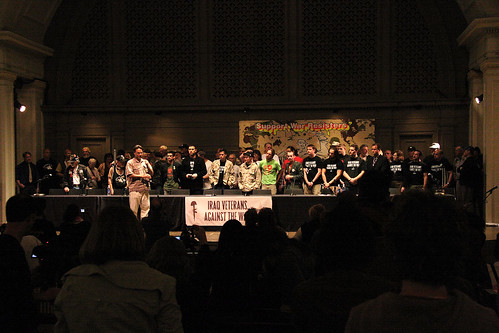
Veterans on Stage

Here's a link to a set of 17 photos from the day's events (panel presentations at Seattle Town Hall, and the march): http://www.flickr.com/photos/rwhitlock/sets/72157605384315166/


Video by Elliot Stoller

Find more video coverage by Stoller here: http://www.youtube.com/view_play_list?p=E195AEBA67A1F3E0M

Iraq Veterans Against the War Winter Soldier Northwest, May 31st, 2008

A series of panels, including a panel of Veterans of the Iraq War, spoke about the continuing horror of the occupation of Iraq. The series of panel presentations were followed by a well attended march through the streets of downtown Seattle.

Panelists spoke about ongoing crimes relating to the occupation, and the negative consequences on the health and well-being of both the occupied and the occupiers. The Iraq people suffer grievous harms, but the soldiers who are asked to perform the duties of an unjust and illegal military action are also made to suffer grievous harm.

The ratio of war injured to war dead for OIF is 8:1 - and that only includes hard injuries, i.e. it doesn't include injuries which are psychological in nature.

Other panel topics included how illegal wars of aggression are enabled by a fundamental racism that exists in society (and especially within military cultures.) Attention was also given to the fraudulent nature of pre-war-pro-war propaganda, a foreign policy of global dominance as it relates to Middle East petroleum resources, and the role of media in the war disaster. The war was sold to the American people as a bill of goods. The invasion was predicated on lies.

Supporting the GI Resistance movement is one of the most promising avenues for stopping the illegal and immoral foreign policy aggression of the government of the United States.

- bert

[June 6, 2008: P.S. Also see this great documentary of the event - this is great coverage - posted on Seattle IndyMedia: http://seattle.indymedia.org/en/2008/06/267013.shtml /June 6,2008]

Matthis Chiroux Refusal to Deploy to Iraq: "The War is Illegal"

June 15, 2008 update: Chiroux refuses deployment


Matthis Chiroux has demonstrated a principled and courageous stand by refusing to deploy to Iraq with the Army of the USA. Here's a story about him from Courage to Resist:
go to original

Sgt Matthis Chiroux declares Iraq recall resistance

"This occupation is unconstitutional and illegal and I hereby lawfully refuse to participate... I refuse to participate in the occupation of Iraq."

Courage to Resist. May 15, 2008

Sgt. Matthis Chiroux served in the Army until being honorably discharged from active duty last summer after over four years in Afghanistan, Japan, Europe and the Philippines. Today he publicly announced that he is refusing orders to be recalled from the Army's Inactive Ready Reserve (IRR) to deploy to Iraq. Matthis took this courageous stand in the Cannon House Office Building Rotunda after fellow members of Iraq Veterans Against the War testified before the Congressional Progressive Caucus.

Video of Sgt. Matthis Chiroux's May 15, 2008 statement

Sgt. Matthis Chiroux. May 15, 2008

Good afternoon. My name is Sgt. Matthis Chiroux, and I served in the Army as a Photojournalist until being honorably discharged last summer after over four years of service in Afghanistan, Japan, Europe and the Philippines. As an Army journalist whose job it was to collect and filter servicemember's stories, I heard many stomach-churning testimonies of the horrors and crimes taking place in Iraq. For fear of retaliation from the military, I failed to report these crimes, but never again will I allow fear to silence me. Never again will I fail to stand.

In February, I received a letter from the Army ordering my return to active duty, for the purpose of mobilization for Operation Iraqi Freedom.

Thanks in great part to the truths of war being fearlessly spoken by my fellow IVAW members, I stand before you today with the strength, clarity and resolve to declare to the military and the world that this Soldier will not be deploying to Iraq.

This occupation is unconstitutional and illegal and I hereby lawfully refuse to participate as I will surely be a party to war crimes. Furthermore, deployment in support of [an] illegal war violates all of my core values as a human being, but in keeping with those values, I choose to remain in the United States to defend myself from charges brought by the Army if they so wish to pursue them. I refuse to participate in the occupation of Iraq.


To donate to Iraq Veterans Against the War Legal Fund to support Matthis, use their online donation form and select “Legal Fund” under special projects. If you would like to send a message of support to Sgt Matthis Chiroux, email thankyoumatthis@ivaw.org

Medea Benjamin at the Green Festival (pt. 1)

This is part one of a multi part series of videos of a speech by Medea Benjamin at the Green Festival. Ms. Benjamin uses the example of Port Militarization Resistance when she mentions the promise of citizen action and civil resistance to stop members of the government from perpetrating acts of aggression. She also discusses the intricate connections between the anti-war and environmental movements.


Here are links to three adjoining videos (of the rest of her speech):

Part Two

Part Three

Part Four

The Right to Engage in Civil Resistance to Prevent State Crimes

This article is a detailed review of Francis A. Boyle's new book, Protesting Power: War, Resistance, and Law. It's by Stephen Lendman. I originally found it on the BaltimoreChronicle.com, but I will link to the version posted on Lendman's own blog here:
go to original

Francis A. Boyle's "Protesting Power - War, Resistance and Law"
Reviewed by Stephen Lendman

Francis A. Boyle is a distinguished University of Illinois law professor, activist, and internationally recognized expert on international law and human rights. From 1988 to 1992, he was a board member of Amnesty International USA. He was a consultant to the American Friends Service Committee. From 1991 to 1993, he was legal advisor to the Palestinian Liberation Organization, and currently he's a leading proponent of an effort to impeach George Bush, Dick Cheney and other key administration figures for their crimes of war against humanity and other grievous violations of domestic and international law. Boyle also lectures widely, writes extensively and authored many books, including his latest one and subject of this review: "Protesting Power - War, Resistance and Law."

Boyle's book is powerful, noble and compelling, and he states its purpose upfront: Today, a "monumental struggle (is being waged) for the heart and soul of (America) and the future of the world...." It matches peacemakers on one side, war makers on the other, and all humanity hanging in the balance. The book provides hope and ammunition. It's an urgent call to action and demonstrates that "civil resistance (is) solidly grounded in international law, human rights (efforts), and the US Constitution." It "can be used to fight back and defeat the legal, constitutional, and humanitarian nihilism of the Bush administration" neocons and their chilling Hobbesian vision - imperial dominance, homeland police state, and permanent "war that won't end in our lifetimes," according to Dick Cheney.

Boyle has the antidote: "civil resistance, international law, human rights, and the US Constitution - four quintessential principles to counter....militarism run amuk." Our choice is "stark and compelling." We must act in our own self-defense "immediately, before humankind exterminates itself in an act of nuclear omnicide." The threat today is dire and real, it demands action, and civil resistance no longer is an option. With survival at stake, it's an obligation.
The Right to Engage in Civil Resistance to Prevent State Crimes

Post-WW II, US foreign policy adopted the political "realism" and "power politics" principles that Hans Morganthau explained in his seminal work on the subject - "Politics among Nations: the Struggle for Power and Peace (1948)." For decades, it was the leading international politics text from a man eminently qualified to produce it and whose experiences under Nazism influenced him.

His cardinal tenet was darkly Hobbesian - that international law and world organizations are "irrelevant" when it comes to conflicts between nations on matters of national interest. Ignore "reality" and perish, but consider the consequences. They've has been disastrous for America, at home and abroad, in a world of our making where life is "solitary, poor, nasty, brutish, and short." No law or justice exists, no sense of right or wrong, no morality, just illusions of what might be, and a "struggle for survival in a state of war" by every nation against all others for one unattainable aim - absolute power and national security at the expense of other states and most people everywhere.

Political "realists" believe that when nations respect international laws and norms and ignore the "iron law" of "power politics," they invite disaster at the hands of aggressors. Boyle believes otherwise and eloquently states it: "Throughout the twentieth century, the promotion of international law, organizations, human rights, and the US Constitution has consistently provided the United States with the best means for reconciling the idealism (and aspirations) of American values....with the realism of world politics and historical conditions."

It can work the way Boyle documented it in his 1999 book, Foundations of World Order: The Legalist Approach to International Relations, 1898 - 1922. In it, he offers a comprehensive analysis of US foreign policy achievements through international law and organizations to settle disputes, prevent wars and preserve peace. It included:

* an obligatory arbitration system for settling disputes between states - the Permanent Court of Arbitration (PCA) in 1899 that's still operating at The Hague as the oldest international dispute resolution institution;
* the Permanent Court of International Justice (World Court) in 1922 that was replaced by the International Court of Justice in 1946 after the UN was established in 1945;
* the codification of important areas of international law in treaty form;
* promoting arms reduction after relaxing international tensions by legal techniques and institutions; and
* convoking periodic peace conferences for all internationally recognized states; the League of Nations was established for this purpose and later the United Nations with its functional agencies like the International Labour Organization, WHO, UNESCO, and IAEA. Other affiliated institutions included the IMF, World Bank, GATT, WTO and regional organizations like the OAS, Arab League, African Union, ASEAN, OSCE and EU. To these add NATO, the Inter-American Treaty of Reciprocal Assistance (the Rio Pact), SEATO, ANZUS and various bilateral self-defense treaties under Article 51 of the UN Charter.

These organizations should have worked. In practice they don't, and Boyle explains why: compared to America's early "legalist, humanitarian, and constitutionalist approach to international relations, geopolitical (realpolitik) practioners of the Hobbesian" school prevailed - men like Johnson, Kissinger, McNamara, Nixon, Byzezinski, Carter, Reagan, GHW Bush, GW Bush, his neocon ideologues and countless others. They disdain democracy, constitutional government and their essential principles: commitment to the rule of domestic and international law, human rights, equal justice and peace.

Consider the cost. It's beyond measure and even worse looking back, in spite of all efforts toward conflict resolution. Since the nation's founding, America has been at war with one or more adversaries every year in our history (without exception), and note the consequences:

* we glorify wars and violence in the name of peace;
* have the highest domestic homicide rate in the western world by far;
* our society is called a "rape culture" and three-fourths of all women are victims of some form of violence in their lifetimes, many repeatedly;
* millions of children are violence or abuse victims and get no help from the state;
* in a nominal democracy under constitutional law, aggressive wars and domestic violence are normal and commonplace; peace, tranquility and public safety are illusions and so are human rights, civil liberties, the rule of law, and common dignity, and the reason it's so is simple - it benefits the privileged few at the expense of the greater good.

What can be done? Plenty, according to Boyle. "Concerned citizens" and people of conscience are obligated to use our available tools - domestic and international law and human rights as "checks and balances against" government abuses of power in the conduct of domestic and foreign policies. Otherwise, administrations can run amuck and literally get away with murder and other major crimes of war, against humanity, peace and the general welfare.

[...]

...Civil resistance is our only hope "to prevent WW III and an (inevitable) nuclear holocaust....Toward that end this book has been written." Read it and act. Apathy isn't an option.
Steve LendmanStephen Lendman lives in Chicago and can be reached at lendmanstephen@sbcglobal.net. Also visit his blog site at sjlendman.blogspot.com, and listen to The Global Research News Hour on RepublicBroadcasting.org Mondays from 11AM - 1PM US Central time.


AUDIO: The Global Research News Hour on RBN

This long article by Stephen Lendman gives a good idea of the topics covered in Boyle's new book.

Why We Resist

go to original
by Chris Hedges
...
We face a crisis. Our democratic institutions are being dismantled. We are headed for a state of perpetual war. We are paralyzed by fear. We will be stripped, if we do not resist, of our few remaining rights. To resist, while there is still time, is not only the highest form of spirituality but the highest form of patriotism. It is, if you care about what is worth protecting in this country, a moral imperative. There are hundreds of thousands who have died in the wars in Iraq and Afghanistan. This number would be dwarfed by a war with Iran, which could ignite a regional inferno in the Middle East. Not a lot is being asked of us. Compare our potential sacrifices with what is being inflicted on and demanded of those trapped in the violence in Iraq, Afghanistan and soon, perhaps, Iran. Courage, as Aristotle wrote, is the highest of human virtues because without it we are unlikely to practice any other virtue. Once we find courage we find freedom.
[May 14, 2008: Perhaps, not a lot is being asked of us, in comparison to those who feel the most severe effects of an oppressive and exploitative U.S.A. foreign policy. But, that does not mean our task of resistance and working for change is, or will be, in any way easy or simple. No, it will take great acts, courage, dedication and persistence in the face of what might, at times, seem like an insurmountable wall of the establishment - and an ingrained and habitual (perhaps mostly unconscious) societal appetite for destruction. It won't be easy. Perhaps the sacrifice won't be great, in comparison. But don't underestimate the "power of the darkside" (so to speak.) It won't be easy. Change won't arrive on the night train. It will require overt and principled, difficult, yet nonviolent confrontation and resistance. May 14, 2008/]

Bombings Kill Dozens in Iraq

Questions:

What is the USA doing in Iraq? Did Iraq pose a threat to the USA prior to the invasion? Were there Weapons of Mass Destruction? Why do millions of Iraqis suffer, their civilian infrastructure so widely reduced to ruin? Is it because of the petroleum resource? Were these deaths necessary? Were they preventable? If the occupation is unjust - if it is wrongful - what can you and I do to stop it?
Two Bombings Kill At Least 26 in N. Iraq
Officials Call for Increase in Security Forces
By Joshua Partlow
Washington Post Foreign Service
Wednesday, December 26, 2007; A14

BAGHDAD, Dec. 25 -- Two bombs ripped through a pair of cities north of Baghdad on Tuesday, causing some of the worst carnage in the country in recent weeks and revealing that, despite the relative calm that has taken hold, insurgent groups remain capable of carrying out devastating attacks.

The morning bombs were detonated in Baiji, an oil refinery town, and Baqubah, a provincial capital where the Sunni insurgent group al-Qaeda in Iraq has lost some of its earlier dominance. The attacks, which killed at least 26 people and wounded as many as 100, prompted calls by officials for an increase in Iraqi soldiers and police in the northern provinces to quell the violence.

In Baqubah, tensions were particularly high because of allegations by Iraqis that, hours before the bombing there, U.S. forces had executed two members of an American-backed volunteer force. The U.S. military denied the accusations.

The bombing in Baiji, near a checkpoint outside a two-story housing complex for oil industry employees, was the more devastating of the two attacks Tuesday...
go to original

PMR Civil Resistance

This is directly related to the PMR protests against the illegal war of occupation in Iraq. For legal expert Francis Boyle, those PMR activists who organized and engaged in civil resistance toward uses of the municipal Port of Olympia, which further and enable an illegal military action, are the true "sheriffs" [sentence updated for grammar Jan 17, 2008]. You can find this article on the UFPPC website. read on:
ANALYSIS: Francis Boyle distinguishes 'civil resistance' from 'civil disobedience'
Written by Madeleine Lee
Friday, 14 December 2007

In a lecture given at Northwestern Law School on Nov. 20, 2007, Prof. Francis A. Boyle asserted, as he has many times while defending Lt. Ehren Watada's refusal to deploy to Iraq, that the Bush administration is a criminal regime:

"[I]n many instances specific components of the Bush Jr. administration's foreign policy constitute ongoing criminal activity under well recognized principles of both international law and United States domestic law."

-- In addition, "all high-level civilian officials and military officers in the U.S. government who either knew or should have known" that those under them were involved in such crimes are also "personally responsible for the commission of international crimes."

-- It follows from this assertion, Prof. Boyle says, that "American citizens possess the basic right under international law and the United States domestic law, including the U.S. Constitution, to engage in acts of civil resistance designed to prevent, impede, thwart, or terminate ongoing criminal activities perpetrated by Bush Jr. administration officials in their conduct of foreign affairs policies and military operations purported to relate to defense and counter-terrorism."

-- Such action constitutes not civil disobedience but "civil resistance." -- Therefore the idea that those who resist must be willing to be punished for their acts is a non sequitur: "Nothing could be further from the truth! Today's civil resisters are the sheriffs! The Bush Jr. administration officials are the outlaws!"

-- "Civil resistance," Boyle said, "is the last hope America has to prevent the Bush Jr. administration from moving even farther down the path of lawless violence."

-- Thus the Port Militarization Resistance movement that began in the Pacific Northwest in 2006 is not civil disobedience with respect to unjust laws, but rather civil resistance undertaken to uphold the rule of law itself: "today's civil resisters are acting for the express purpose of upholding the rule of law, the U.S. Constitution, human rights, and international law. Applying the term 'civil disobedience' to such civil resistors mistakenly presumes their guilt and thus perversely exonerates the Bush Jr. administration criminals."

...
You can read the rest here.

Here are a couple more quotes that I like. Part of the first one was included above:

Stop the War "Today in international legal terms, the Bush Jr. administration itself should now be viewed as constituting an ongoing criminal conspiracy under international criminal law in violation of the Nuremberg Charter, the Nuremberg Judgment, and the Nuremberg Principles, because of its formulation and undertaking of serial wars of aggression, crimes against peace, crimes against humanity, and war crimes that are legally akin to those perpetrated by the former Nazi regime in Germany. As a consequence, American citizens possess the basic right under international law and the United States domestic law, including the U.S. Constitution, to engage in acts of civil resistance designed to prevent, impede, thwart, or terminate ongoing criminal activities perpetrated by Bush Jr. administration officials in their conduct of foreign affairs policies and military operations purported to relate to defense and counter-terrorism." - Francis A. Boyle

and

"If you believe Dante may be right, that 'the hottest places in hell are reserved for those who, in time of moral crisis, remain neutral,' you need this book. . . . If you are concerned that our country lives by its Constitution and laws, its often-proclaimed principles . . . you too should read this book. . . . If you cherish freedom, here is your chance to learn how much you have. A person ignorant of her rights has little advantage over those who have none." - Ramsey Clark, Former U.S. Attorney General
[ Original source: Rowman & Littlefield]

[3/12/2008 Update:] Francis Boyle's most recent book is titled Protesting Power. Here's a link to the publisher's website: http://www.rowmanlittlefield.com/Catalog/SingleBook.shtml?command=Search&db=^DB/CATALOG.db&eqSKUdata=0742538923

LTE re: protest and media

I just sent this off to The Olympian after some considerable wrangling with the word count. I like it. Except for the part in paragraph two, which is kind of confusing. I was trying to pack too many ideas into 250 words.

I intended to communicate that embedded reports have become the norm in the mainstream media. This allows untoward influence over the quality, context and content of journalistic reports.

Separately, though similarly, I intended to draw attention to the fact that the media reprints - as truth - with little to no question about the veracity of the statements, or the integrity of what are virtually anonymous sources, stories that originate from military communications personnel (who have incentive to portray the stories under a favorable, and hence oftentimes false, light.) A good example of this is the media reporting of what happened in and around Fallujah, Iraq soon after the opening days of the invasion/occupation in 2003. Dahr Jamail has compiled good reports about the discrepancy between on the ground reality and reports that the media was being fed by military sources and subsequently presenting as truth in a regurgitated form.

So here's my decidedly imperfect letter:
December 11th, 2007

To the Editor,

Certain prominent officials within the Bush Administration continue to perpetrate and to get away with a wrongful, aggressive and illegal war of occupation in Iraq. There are many factors which enable the Bush Administration's imperial aspirations; not least among them are the politics of fear and division, the leverage of a compliant Congress, and an apathetic Public.

But the Bush Administration may be most enabled in its pursuit of global dominance by a compliant and cooperative mainstream media. For example, embedded military reports are taken at face value with little to no question about the veracity of what are oftentimes virtually anonymous sources. In its compliance with the Bush Administration politics of fear and division, the mainstream media do the USA harm.

Iraq did not pose a threat to the USA prior to invasion.

Our nation's military and military personnel are being misused, and abused, in the service of an unjust and aggressive occupation.

The port blockades were an attempt to stop an unlawful occupation; one that is hurting the people of Iraq and the uniformed service personnel of the USA. To speak against the blockades is comparable to saying that a police officer should not drive in excess of the speed limit in order to apprehend a suspect.

Millions of people in Iraq suffer on a daily basis because of the war. Their suffering goes unreported or glossed over. Where are their voices in our media? Why don't we hear from those who are most impacted by this 'war?'

Thank you and sincerely,

Robert Whitlock

Olympia
[edit added Dec. 12:] Yes - the blockades were an attempt to hold the Bush Administration accountable for the wrongful making of war. They were, for me, an attempt to confine the military vehicles on port property until the commencement of a responsible, safe and complete withdrawal from Iraq.

The blockades were, for me, an attempt to serve the interests of justice by shutting down an intolerable and immoral crusade for control over the petroleum resource of Iraq, a crusade for geopolitical and economic dominance.

I think there is a valid argument to be made that the protests were legal because they were an attempt to hold an Executive Administration that has run riot with the military resources of the USA to account for its wrongdoing. Congress is delinquent. There is abundant evidence to reasonable conclude that prominent members of the Bush Administration have committed heinous and grievous wrongdoings in their respective quests for global dominance and personal power.

The War is Illegal

This is something that I whipped up on the "haloscan" comments section of The Olympian newspaper. I have edited it slightly for publication here:

The war can reasonably be understood to be illegal. Let me illustrate by using a couple of examples. Say that an underage person enters a tavern and uses a piece of fake identification to purchase and consume an alcoholic beverage. The purchase and consumption by an underage patron is not lawful, even if he or she is never called into question. Another example: if a corporation or other entity uses false evidence and makes false claims in order to justify a particular action - then its actions can rightly be understood to be illegal - it's called fraud.

Prior to the invasion of Iraq, prominent officials within the Bush Administration made (and continue to make) false claims about the threat that Iraq posed (primarily via WMD.)

Just because Congress (in a condition of delinquency) has not exercised appropriate and necessary oversight authority - just because the Bush Administration's conspiracy to defraud the Congress and the People has not been tried in a court of law - doesn't mean that the Bush Administration has not violated relevant laws. The law of the land is clear. To wage an aggressive military action is highly illegal (and immoral.)

Because the matter has not (to my knowledge) been reconciled in an appropriate court of law, and because Congress has failed to exercise appropriate oversight authority, the burden falls on The People.

There were no WMD in Iraq to threaten either the USA or its allies. There was not proper justification for the invasion.

It can be rightly understood that the invasion was an aggressive military action - motivated by the aspiration amongst certain prominent Bush Administration officials to control the petroleum resource of Iraq.

Therefore, the use of the municipal Port of Olympia to further and enable the continuously aggressive occupation of Iraq is inappropriate, and unlawful, in a very real sense.

Millions of people in Iraq are suffering right now, because of the belligerent war making of the Bush Administration.

The Uniformed Services of the USA are being misused and abused to further an aggressive foreign occupation.

We have an opportunity, right here in Olympia, to do something about it.

Rather than recouping the costs from PMR Protesters whose only motive was to further the causes of peace and justice, I argue that the costs of the protests should be paid by those who profit off of an unjust and unlawful aggressive military action.
 
Aldo Leopold: "We abuse land because we regard it as a commodity belonging to us. When we see land as a community to which we belong, we may begin to use it with love and respect."

keywords: peace, justice, truth, love, wisdom, common sense, ethics, nonviolence, compassion, communication, community, egalitarian, equitable, society, culture, future, politics, government, public interest, sustainability, economy, ecology, nature, beauty, urban issues, environment, wilderness, energy, industry, reciprocity, karma, dignity, honor, patience, life, photography, music, flowers, and more!