I just posted at olyblog about Ron Suskind's interview at DemocracyNow.org. Here's a link to the olyblog.net post: olyblog.net/house-judiciary-opens-investigation...
His book is titled, The Way of the World: A Story of Truth and Hope in an Age of Extremism. The DN interview is in two parts, over two days. The second interview also includes Representative John Conyers, who is the Chair of the House Judiciary Committee. The HJC has recently opened a Congressional Probe into the accusations of forgery contained in the Suskind book.
peace
Showing posts with label prewar intelligence fraud. Show all posts
Showing posts with label prewar intelligence fraud. Show all posts
A Conspiracy to Defraud the United States
I advocate for the impeachment of members of the Bush Administration. There are various examples of malfeasance that are worthy of, and indeed - that necessitate impeachment. Here's a excerpt from Elizabeth de la Vega's book United States v. George Bush et al.. A trial might look something like this:
[go to original]link to original [read the rest]
...
11. Pursuant to the Constitution, their oaths of office, their status as Executive Branch employees, and their presence in the United States, BUSH, CHENEY, RICE, RUMSFELD, and POWELL, and their subordinates and employees, are required to obey Title 18, United States Code, Section 371, which prohibits conspiracies to defraud the United States.
12. As used in Section 371, the term "to defraud the United States" means "to interfere with or obstruct one of its lawful government functions by deceit, craft, trickery, or at least by means that are dishonest." The term also means to "impair, obstruct, or defeat the lawful function of any department of government" by the use of "false or fraudulent pretenses or representations."
13. A "false" or "fraudulent" representation is one that is: (a) made with knowledge that it is untrue; (b) a half-truth; (c) made without a reasonable basis or with reckless indifference as to whether it is, in fact, true or false; or (d) literally true, but intentionally presented in a manner reasonably calculated to deceive a person of ordinary prudence and intelligence. The knowing concealment or omission of information that a reasonable person would consider important in deciding an issue also constitutes fraud.
14. Congress is a "department of the United States" within the meaning of Section 371. In addition, hearings regarding funding for military action and authorization to use military force are "lawful functions" of Congress.
15. Accordingly, the presentation of information to Congress and the general public through deceit, craft, trickery, dishonest means, and fraudulent representations, including lies, half-truths, material omissions, and statements made with reckless indifference to their truth or falsity, while knowing and intending that such fraudulent representations would influence Congress' decisions regarding authorization to use military force and funding for military action, constitutes interfering with, obstructing, impairing, and defeating a lawful government function of a department of the United States within the meaning of Section 371.The Conspiracy to Defraud the United States
16. Beginning on or about a date unknown, but no later than August of 2002, and continuing to the present, in the District of Columbia and elsewhere, the defendants,
GEORGE W. BUSH,
RICHARD B. CHENEY,
CONDOLEEZZA RICE,
DONALD M. RUMSFELD, and
COLIN M. POWELL,
and others known and unknown, did knowingly and intentionally conspire to defraud the United States by using deceit, craft, trickery, dishonest means, false and fraudulent representations, including ones made without a reasonable basis and with reckless indifference to their truth or falsity, and omitting to state material facts necessary to make their representations truthful, fair and accurate, while knowing and intending that their false and fraudulent representations would influence the public and the deliberations of Congress with regard to authorization of a preventive war against Iraq, thereby defeating, obstructing, impairing, and interfering with Congress' lawful functions of overseeing foreign affairs and making appropriations.
17. The Early Months of the Bush-Cheney Administration: Prior to January of 2001, BUSH, CHENEY, and RUMSFELD each demonstrated a predisposition to employ U.S. military force to invade the Middle East, including, specifically, to forcibly remove Saddam Hussein.
18. Since 1992, CHENEY has endorsed a "bold foreign policy" that includes using military force to "punish" or "threaten to punish" possible aggressors in order to protect the United States's access to Persian Gulf oil and to halt proliferation of weapons of mass destruction ("WMD"), a term that is customarily used to describe chemical, biological, and nuclear weapons.
...
Bush Style Destruction
I want to point out an interesting article by a self described Reagan Conservative - and an economist - who happens to also be anti-war and decidedly anti-Bush Administration:
go to original
"How Bush Changed My Life"
by David R. Henderson
...
Until 9/11. Like almost everyone else in America and, indeed, most people in the world, I was outraged by the 19 criminals who murdered 3,000 innocent victims. But when George Bush said, on that very same day, "Freedom itself was attacked this morning by a faceless coward … and freedom will be defended," I smelled a rat. In saying that freedom was attacked, Bush was saying something about the motives of the attackers, even though he couldn't have known that soon what their motives were. So it seemed to me that Bush was trying to set the groundwork for a war rather than trying to go after the higher-ups behind the perpetrators. I turned out to be right. In response to 9/11, George Bush made war on Afghanistan and, depending on which audience he and Dick Cheney were speaking to, a response to 9/11 was part of their motive in attacking Iraq.
...
"We're an empire now and when we act we create our own reality."
 Karl Rove, aka "Turd Blossom," is widely believed to be "Bush's Brain." Rove is a key rhetoritician in the Bush Administration and he can take credit for a lot of the Administration's radical political strategies. That's important to understand. The Bush Administration is radical. It is using the might of the US government and military to wage war for the benefit of corporations. It is rolling back environmental protections, and instituting a horribly regressive tax structure. I could go on and on about my disagreements with the Bush Administration's policies and strategies. But instead, I'll point you to Tom Englehardt's Tomdispatch.com, where you can find Mark Danner's recent epistle on the Executive Rhetoric, from a "reality-based" point of view:
go to originalThanks for that insightful oratory, Mark Danner.
...in September 2003, the rhetorical construction known as the War on Terror was already two years old and that very real war to which it gave painful birth, the war in Iraq, was just hitting its half-year mark. Indeed, the Iraq War had already ended once, in that great victory scene on the USS Abraham Lincoln off the coast of San Diego, where the President, clad jauntily in a flight suit, had swaggered across the flight deck and, beneath a banner famously marked "Mission Accomplished," had declared: "Major combat operations in Iraq have ended. In the battle of Iraq, the United States and our allies have prevailed."
Of the great body of rich material encompassed by my theme today -- "Words in a Time of War" -- surely those words of George W. Bush must stand as among the era's most famous, and most rhetorically unstable. For whatever they may have meant when the President uttered them on that sunny afternoon of May 1, 2003, they mean something quite different today, almost exactly four years later. The President has lost control of those words, as of so much else.
...
Critical to this strange and unlikely history were the administration's peculiar ideas about power and its relation to reality -- and beneath that a familiar imperial attitude, if put forward in a strikingly crude and harsh form: "We're an empire now and when we act we create our own reality." Power, untrammeled by law or custom; power, unlimited by the so-called weapons of the weak, be they international institutions, courts, or terrorism -- power can remake reality. It is no accident that one of Karl Rove's heroes is President William McKinley, who stood at the apex of America's first imperial moment, and led the country into a glorious colonial adventure in the Philippines that was also meant to be the military equivalent of a stroll in the park and that, in the event, led to several years of bloody insurgency -- an insurgency, it bears noticing, that was only finally put down with the help of the extensive use of torture, most notably water-boarding, which has made its reappearance in the imperial battles of our own times.
...
...the weapons were a rhetorical prop and, satisfying as it has been to see the administration beaten about the head with that prop, we forget this underlying fact at our peril. The issue was never whether the weapons were there or not; indeed, had the weapons really been the issue, why could the administration not let the UN inspectors take the time to find them (as, of course, they never would have)? The administration needed, wanted, had to have, the Iraq war. The weapons were but a symbol, the necessary casus belli, what Hitchcock called the Maguffin -- that glowing mysterious object in the suitcase in Quentin Tarantino's Pulp Fiction: that is, a satisfyingly concrete object on which to fasten a rhetorical or narrative end, in this case a war to restore American prestige, project its power, remake the Middle East.
...
How, in these "words in a time of war," can I convey to you the reality of that place at this time? Let me read to you a bit of an account from a young Iraqi woman of how that war has touched her and her family, drawn from a newsroom blog. The words may be terrible and hard to bear, but -- for those of you who have made such a determined effort to learn to read and understand -- this is the most reality I could find to tell you. This is what lies behind the headlines and the news reports and it is as it is."We were asked to send the next of kin to whom the remains of my nephew, killed on Monday in a horrific explosion downtown, can be handed over...The foregoing were words from an Iraqi family, who find themselves as far as they can possibly be from the idea that, when they act, they create their own reality -- that they are, as Bush's Brain put it, "history's actors." The voices you heard come from history's objects and we must ponder who the subjects are, who exactly is acting upon them.
"So we went, his mum, his other aunt and I...
"When we got there, we were given his remains. And remains they were. From the waist down was all they could give us. ‘We identified him by the cell phone in his pants' pocket. If you want the rest, you will just have to look for yourselves. We don't know what he looks like.'
"…We were led away, and before long a foul stench clogged my nose and I retched. With no more warning we came to a clearing that was probably an inside garden at one time; all round it were patios and rooms with large-pane windows to catch the evening breeze Baghdad is renowned for. But now it had become a slaughterhouse, only instead of cattle, all around were human bodies. On this side; complete bodies; on that side halves; and everywhere body parts.
"We were asked what we were looking for; ‘upper half' replied my companion, for I was rendered speechless. ‘Over there.' We looked for our boy's broken body between tens of other boys' remains; with our bare hands sifting them and turning them.
"Millennia later we found him, took both parts home, and began the mourning ceremony."
...
The nation and congress were misled into the invasion of Iraq. It's time to bring the truth to the fore and begin the process of reconciliation and remediation. A good first step would be to hold those responsible for this terrible breach of the public trust to account for their actions.
Certainly an uphill climb awaits. But that does not justify dalliance. I, at least, hold them accountable.
Still Looking for WMD in Iraq
Why did the US invade Iraq? Wasn't it because Iraq posed a threat to US National Security via WMD? Well no WMD has been found in over four years of occupation. The chances of finding a significant enough cache that might have threatened the US is getting smaller by the day.
We already heard (via the Downing Street Memo) how the facts were being fixed to the policy of invading Iraq. It looks more and more like WMD was simply one of those "facts" that grew out of a fiction. And it was used, in violation of the public trust, to justify invading Iraq. In that light, the invasion was an attack - an aggressive invasion - an belligerent act of war.
Hideous. Read about the continuing mission to discover WMD in Iraq:
We already heard (via the Downing Street Memo) how the facts were being fixed to the policy of invading Iraq. It looks more and more like WMD was simply one of those "facts" that grew out of a fiction. And it was used, in violation of the public trust, to justify invading Iraq. In that light, the invasion was an attack - an aggressive invasion - an belligerent act of war.
Hideous. Read about the continuing mission to discover WMD in Iraq:
go to original
Though Work Is Seen as Irrelevant, Security Council Can't Agree to End It
By Colum Lynch
Washington Post Staff Writer
Saturday, June 2, 2007; A01
UNITED NATIONS -- More than four years after the fall of Baghdad, the United Nations is spending millions of dollars in Iraqi oil money to continue the hunt for Saddam Hussein's alleged weapons of mass destruction.
Every weekday, at a secure commercial office building on Manhattan's East Side, a team of 20 U.N. experts on chemical and biological weapons pores over satellite images of former Iraqi weapons sites. They scour the international news media for stories on Hussein's deadly arsenal. They consult foreign intelligence agencies on the status of Iraqi weapons. And they maintain a cadre of about 300 weapons experts from 50 countries and prepare them for inspections in Iraq -- inspections they will almost certainly never conduct, in search of weapons that few believe exist.
The inspectors acknowledge that their chief task -- disarming Iraq -- was largely fulfilled long ago. But, they say, their masters at the U.N. Security Council have been unable to agree to either shut down their effort or revise their mandate to make their work more relevant. Russia insists that Iraq's disarmament must be formally confirmed by the inspectors, while the United States vehemently opposes a U.N. role in Iraq, saying coalition inspectors have already done the job.
"I recognize this is unhealthy," said Dimitri Perricos, a Greek weapons expert who runs the team, known as the U.N. Monitoring, Verification and Inspection Commission (UNMOVIC), and manages its $10 million annual budget. But, he added, "we are not the ones who are holding the purse; the one who is holding the purse is the council."
There was a time when the work of U.N. weapons inspectors on Iraq was the stuff of front-page news and impassioned speeches by world leaders. President Bush even argued that Hussein's refusal to cooperate with U.N. inspectors offered legal backing for the 2003 invasion.
But the inspectors' primary mission -- ridding Hussein's regime of chemical, biological and nuclear weapons -- has become irrelevant since a U.S.-led coalition toppled the Iraqi leader and discovered that his government had destroyed its most lethal weapons shortly after the 1991 Persian Gulf War.
"The reality on the ground is there is no WMD there," said Charles Duelfer, a former U.N. weapons inspector who published the landmark 2004 report of the CIA-led Iraq Survey Group, which concluded that Iraq's weapons had been destroyed. "I think they understand the distance their work is from reality."
...
Responding to President Bush
From the BBC: US President George W Bush has shared intelligence that Osama Bin Laden was seeking in 2005 to set up an al-Qaeda cell in Iraq to strike US targets.These allegations from President Bush have no credibility. He also said that there was WMD in Iraq. He said that Saddam Hussein posed a threat to US targets maybe even in the form of mushroom clouds from nuclear explosions.
President Bush is known to have been involved in a scheme wherein the "facts were being fixed around the policy" of invading Iraq.
I would advise taking the President's assessment of threat with a grain of salt.
God forbid against more terrorist attacks in the USA. But it seems that Bush's unjustified and unnecessary invasion of Iraq has opened the window to the increased possibility of such attacks. The invasion and occupation have inflamed anti-US sentiments. The occupation leaves the USA open to retaliation.
It's time to begin the healing process by implementing a systematic and complete withdrawal of US forces from Iraq.
Congress Girds for Oversight Procedures
Well, it's about time.
go to original
go to original
Congress girds up for return to oversight
Probes include alleged contracting abuses in Iraq and the alteration of scientific findings.
By Gail Russell Chaddock | Staff writer of The Christian Science MonitorWASHINGTON - Not since the Depression-era Congress of 1932 has Capitol Hill ramped up so quickly for oversight hearings and related legislation – most targeting the Bush administration.
Both ends of Pennsylvania Avenue are hiring more lawyers, and watchdog groups say they are swamped with calls from committee staff asking for advice on pursuing the nearly lost art of congressional investigation.
In its first 100 days, the new Congress launched probes on allegations ranging from contracting abuses in Iraq and the alteration of scientific findings to the misuse of federal resources for partisan purposes. Some hearings, such as those on last year's firing of eight US attorneys, were snatched from the headlines; others are longer-term campaigns to try to uncover any government waste and to expand the public's access to how government conducts its business.
...
The Lies that Led to War
Great film from the CBC's Fifth Estate about the misleadership and deception that precipitated the invasion of Iraq.

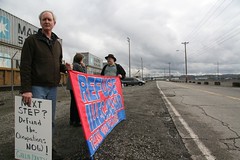
Constitution in Crisis: The Case for Impeachment
Last night I attended the town hall meeting Constitution in Crisis: The Case for Impeachment.
It was a great event, inspiring and very compelling. I am encouraged to step up the pressure on congress to move forward with investigations into impeachable offenses committed by the Bush Administration.
Here are some pictures:
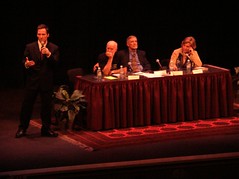
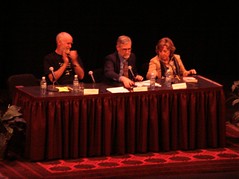
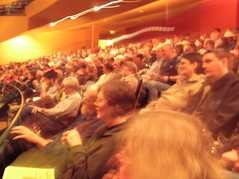
(pictures are linked to larger versions.)
The meeting was very well attended, the Washington Center for the Performing Arts was packed. I don't know how many it holds, but I would estimate that there might have been as many as 3,000 people there. [edit: although it was packed, I don't think that it holds 3,000. There was close to 1,000 though. I just checked the seating capacity.]
The panelists made a very persuasive argument that to hold impeachment hearings, based even on only the evidence currently available to the public, is a necessity.
Here's the video:
It was a great event, inspiring and very compelling. I am encouraged to step up the pressure on congress to move forward with investigations into impeachable offenses committed by the Bush Administration.
Here are some pictures:
(pictures are linked to larger versions.)
The meeting was very well attended, the Washington Center for the Performing Arts was packed. I don't know how many it holds, but I would estimate that there might have been as many as 3,000 people there. [edit: although it was packed, I don't think that it holds 3,000. There was close to 1,000 though. I just checked the seating capacity.]
The panelists made a very persuasive argument that to hold impeachment hearings, based even on only the evidence currently available to the public, is a necessity.
Here's the video:
Pentagon Deception
Two more years of this. And then what? Something has to give.
go to original
_
Pentagon office produced 'alternative' intelligence on Iraq
By Jonathan S. Landay
McClatchy Newspapers
WASHINGTON - A special unit run by former Secretary of Defense Donald H. Rumsfeld's top policy aide inappropriately produced "alternative" intelligence reports that wrongly concluded that Saddam Hussein's regime had cooperated with al-Qaida, a Pentagon investigation has determined.
The Department of Defense Inspector General's Office found that former Undersecretary of Defense Douglas Feith and his staff had done nothing illegal or unauthorized.
But Sen. Carl Levin, D-Mich., who requested the investigation, called the findings "devastating" because senior administration officials, particularly Vice President Dick Cheney, used Feith's work to help make their case for the 2003 U.S. invasion of Iraq.
...
go to original
_
Iran and Iraq and 'Inconsistent' Intelligence
Two stories to keep you busy this weekend, dear reader (i.e. Mom.)
go to originaland
Senators Debate Significance of Pentagon Report On Intelligence
By Walter Pincus and Karen DeYoung
Washington Post Staff Writers
Saturday, February 10, 2007; Page A01
Senate Democrats and Republicans disagreed yesterday over the meaning and importance of a Defense Department inspector general's conclusion that a Pentagon policy office produced and gave senior policymakers "alternative intelligence assessments on Iraq and Al Qaida relations" that were "inconsistent" with the intelligence community's consensus view in the lead-up to the U.S. invasion of Iraq.
...
go to original[edit]and one more:
Iran will strike U.S. interests if attacked
By Jonathan S. Landay
McClatchy Newspapers
WASHINGTON - Iran's supreme leader ratcheted up tensions with the United States on Thursday, warning that his country would strike American interests around the world in retaliation for any U.S. strike on Iran.
At the same time, a senior Iranian diplomat said that his country was ready to participate in diplomatic efforts to reduce instability in the Middle East, including the sectarian bloodshed unleashed by the U.S. invasion of Iraq.
The Iranian statements follow U.S. charges that Tehran is shipping weapons to Shiite Muslim militias in Iraq for attacks on American forces. U.S. and Iraqi forces have detained Iranian operatives in Iraq, and President Bush's dispatched a second aircraft carrier strike force and additional anti-missile batteries to the Persian Gulf.
...
go to original
Target Iran: US able to strike in the spring
Despite denials, Pentagon plans for possible attack on nuclear sites are well advanced
Ewen MacAskill in Washington
Saturday February 10, 2007
The Guardian
US preparations for an air strike against Iran are at an advanced stage, in spite of repeated public denials by the Bush administration, according to informed sources in Washington.
The present military build-up in the Gulf would allow the US to mount an attack by the spring. But the sources said that if there was an attack, it was more likely next year, just before Mr Bush leaves office.
Neo-conservatives, particularly at the Washington-based American Enterprise Institute, are urging Mr Bush to open a new front against Iran. So too is the vice-president, Dick Cheney...
Legality of U.S. Actions in Iraq
Two weeks ago, citizens from around the United States gathered at The Evergreen State College Tacoma Campus for a hearing on the legality of U.S. actions in Iraq. The gathering was prompted by First Lieutenant Ehren Watada's (thankyoult.org) courageous refusal to deploy for service in what he considers to be the illegal and immoral occupation of Iraq.
Watada believes that the war was justified on false premises, and that there was no true military cause or necessity for the invasion and subsequent ongoing occupation. As such, the war can be seen as a war of choice, i.e. a war of aggression.
The Citizen's Hearing panelists have recently released a report of their findings. It can be found here.
Please support Watada's courageous and principled stand in opposition to an illegal, immoral, aggressive and imperialist military action.
Watada believes that the war was justified on false premises, and that there was no true military cause or necessity for the invasion and subsequent ongoing occupation. As such, the war can be seen as a war of choice, i.e. a war of aggression.
The Citizen's Hearing panelists have recently released a report of their findings. It can be found here.
Please support Watada's courageous and principled stand in opposition to an illegal, immoral, aggressive and imperialist military action.
The Boy Who Cried Wolf
go to original
Congress and the American People have a duty to prevent a further escalation of military operations in the Middle East (as well as the rest of the world.) De-escalate, Bring the Troops Home, Restore Moral Standing to the USA by holding the Bush Administration accountable.
The Bush Administration certainly deserves no benefit of the doubt... President Bush, more than anything, deserves to be confined until he can be brought to trial for high crimes and misdemeanors, using deliberate misrepresentations to market an unjustified and aggressive military invasion of a sovereign nation. The Bush Administration's rush to war in Iraq is in violation of more than one legal statute.
News Analysis: Confronting Iran, Bush burdened with legacy of Iraq distortions
By David E. Sanger
Published: January 28, 2007
WASHINGTON:
As President George W. Bush and his aides calibrate an escalating confrontation with Iran, they are discovering that their words and strategies are haunted by echoes from four years ago — when their warnings of terrorist activity and nuclear ambitions were clearly a prelude to war.
This time, they insist, it is different...

Congress and the American People have a duty to prevent a further escalation of military operations in the Middle East (as well as the rest of the world.) De-escalate, Bring the Troops Home, Restore Moral Standing to the USA by holding the Bush Administration accountable.
Tony Blair Implicated in Iraq War Fraud
Damning information:
Diplomat's Suppressed Document Lays Bare the Lies Behind Iraq WarHere's a link.
By Colin Brown and Andy McSmith
The Independent UK
Friday 15 December 2006...
The Government's case for going to war in Iraq has been torn apart by the publication of previously suppressed evidence that Tony Blair lied over Saddam Hussein's weapons of mass destruction.
A devastating attack on Mr Blair's justification for military action by Carne Ross, Britain's key negotiator at the UN, has been kept under wraps until now because he was threatened with being charged with breaching the Official Secrets Act.
Representative Cynthia McKinney's Bill to Impeach President George Bush
Here are some excerpts from Representative McKinney's on-floor introduction to her impeachment bill. This was introduced in Congress last Friday:
The message is clear. It is the Peoples' responsibility and duty to enforce accountability!
By Cynthia McKinney, December 8, 2006A full text can be found here: http://www.afterdowningstreet.org/node/16230.
Mr. Speaker:
I come before this body today as a proud American and as a servant of the American people, sworn to uphold the Constitution of the United States.
...
No American is above the law, and if we allow a President to violate, at the most basic and fundamental level, the trust of the people and then continue to govern, without a process for holding him accountable—what does that say about our commitment to the truth? To the Constitution? To our democracy?
...
From mushroom clouds to African yellow cake to aluminum tubes, the American people and this Congress were not presented the facts, but rather were presented a string of untruths, to justify the invasion of Iraq.
...
This has grave consequences for the health of our democracy, for our standing with our allies, and most of all, for the lives of our men and women in the military and their families—who have been asked to make sacrifices—including the ultimate sacrifice—to keep us safe.
Just as we expect our leaders to be truthful, we expect them to abide by the law and respect our courts and judges. Here again, the President failed the American people.
...
President George W. Bush has failed to preserve, protect, and defend the Constitution of the United States; he has failed to ensure that senior members of his administration do the same; and he has betrayed the trust of the American people.
With a heavy heart and in the deepest spirit of patriotism, I exercise my duty and responsibility to speak truthfully about what is before us. To shy away from this responsibility would be easier. But I have not been one to travel the easy road. I believe in this country, and in the power of our democracy. I feel the steely conviction of one who will not let the country I love descend into shame; for the fabric of our democracy is at stake.
...
Mr. Speaker:
Under the standards set by the United States Constitution, President Bush—along with Vice President Cheney, and Secretary of State Rice—should be subject to the process of impeachment, and I have filed H. Res. _ in the House of Representatives.
To my fellow Americans, as I leave this Congress, it is in your hands—to hold your representatives accountable, and to show those with the courage to stand for what is right, that they do not stand alone.
Thank you.
The message is clear. It is the Peoples' responsibility and duty to enforce accountability!
Subscribe to:
Posts (Atom)