Why do corporations have rights when living ecosystems do not?
Please watch this very important, interesting, and powerful speech by Mari Margil.
Mari Margil speaks to the 2009 Bioneers conference in the spirit of The Lorax:
Protecting Against Environmental Degradation by Recognizing the Rights of Nature
I am also reminded about another set of important videos that have powerful ideas to share.
The Story of Stuff. And also The Story of Cap and Trade.
There are also a couple other videos in the production queue.
This is really really awesome work by Annie Leonard. Please also take time to see these important videos. http://www.storyofstuff.com/
It's all good food for thought.
Showing posts with label climate change. Show all posts
Showing posts with label climate change. Show all posts
The Story of Cap and Trade Video
This is a great video. A must see.
Here's a comment I left on youtube:
The video:
The Story of Cap and Trade
Here's a comment I left on youtube:
The wealth of developed nations is based not only on ingenuity and hard work. The wealth of developed nations is also critically based on oppression and violence, including slavery and environmental degradation (greenhouse gas pollution very much included.)
The myth of meritocracy runs rampant in American culture.
It's important to realize that much of our material "success" is based not on merit - but instead on oppression and violence, on expropriation and exploitation.
The video:
The Story of Cap and Trade
The Billionaires for Coal, yahoo!
The Billionaires for Coal: "It's not my problem!

Dispatches from the Coal Finance Day of Action Front (Updated 11-19-07)
Dispatches from the Coal Finance Day of Action Front (Updated 11-19-07)
We Face a Stark Choice
Vandana Shiva (Founder of Navdanya):
"Regulating by carbon trading is like fiddling as Rome burns. Governments and the UN should impose a carbon tax on corporations, both for production - wherever their facilities are located - and for transport, which the Kyoto Protocol does not account for directly. Incentives for renewable energy are also essential. We face a stark choice: we can destroy the conditions for human life on the planet by clinging to 'free-market' fundamentalism, or we can secure our future by bringing commerce within the laws of ecological sustainability and social justice." [emphasis added]
How can I live in a way that is truly happy, secure, and peaceful when I know that the ways of human societies are ruining the conditions for human life on Earth and dooming future generations to poverty?
...Earth democracy...transition...put nature first...
...respect and protect wilderness...nurture broken ecosystems, repair them, bring them back to health...restore ecological and economic balance...
Vandana Shiva scheduled to speak in Olympia, October 15: Vandana Shiva visit to Olympia, Washington
40 Years after the Nuclear Nonproliferation Treaty and Global Climate Disruption
From Democracy Now!:
Forty Years After Nuclear Non-Proliferation Treaty, US Tops World in Nuke ArsenalAnd also, climate disruption caused by anthropogenic forces:
This week marks the fortieth anniversary of the Nuclear Non-Proliferation Treaty, when nuclear powers agreed to eventually eliminate their nuclear weapons, and non-nuclear states agreed not to seek to develop nuclear weapons capabilities. Forty years later, there are 189 signatories to the treaty and nine nuclear armed states in the world. The United States and Russia still have the world’s largest stockpile of nuclear weapons. We speak with Joseph Cirincione, president of the Ploughshares Fund and author of Bomb Scare: The History and Future of Nuclear Weapons.
...
Leading scientist John Holdren says ‘global warming’ is not the correct term to use, he prefers ‘global disruption.’ “Global warming] is misleading, it implies something that is mainly about temperature, that’s gradual, and that’s uniform across the planet,” says Holdren. “In fact, temperature is only one of the things that’s changing it’s sort of an index of the state of the climate. The whole climate is changing: the winds, the ocean currents, the storm patterns, snowpack, snowmelt, flooding, droughts—temperature is just a bit of it.”
As we continue our discussion on global warming, I am joined here in Aspen by one of the country’s top scientists, John Holdren. He is Professor of Environmental Policy at Harvard’s Kennedy School of Government and director of the Science, Technology and Public Policy Program at the Belfer Center for Science and International Affairs. He is also the director of the Woods Hole Research Center, and just completed a term as board chair of the American Association for the Advancement of Science. During the 1990s he advised President Clinton as a member of the President’s Committee of Advisors on Science and Technology. In addition to global warming, John Holdren’s research has focused on energy technology, nuclear nonproliferation and arms control.
John Holdren, professor of Environmental Policy at the Kennedy School of Government at Harvard University. He is the director of the Woods Hole Research Center, and just completed a term as board chair of the American Association for the Advancement of Science.
Back from the long road...
I'm back in Olympia after a long road trip. Nearly two weeks of travels and 2,500 miles through the states of Washington, Oregon, and California. I did so much stuff, it's hard to decide where to start. But anyway, I drove first to Auburn California where my Grandmother lives in a gracious retirement community. I spent a couple of enjoyable days with her - I even won about $40 at the slots on Sunday.
From there I went to a small town in the heart of the Sierra Nevada Mountains to visit my Uncle Brandt and his wife Stevee. They live in a cool house in a beautiful spot right on the side of a mountain that stretches up 9,000 feet.
I left early on Tuesday morning to get to Yosemite in the early afternoon. The highlight from that stay was a 10 hour hike up to, and back from, the summit of half dome. It was about 17 miles with an elevation gain (and loss) of nearly 5,000 feet. More on that later.
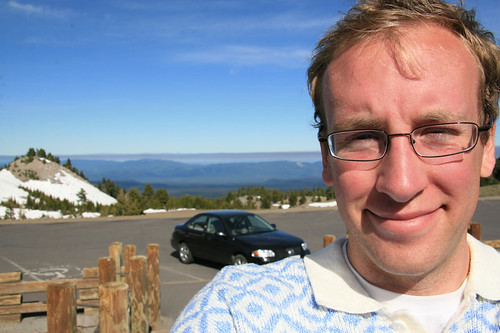
This picture is from Crater Lake as I stood looking out over one of the deepest lakes in the world. Crater lake is almost 2,000 feet deep. The lake's remoteness and isolation make it a special system for studying the effects of humans on climate. The water temperature and surrounding air temperature both show increases over the past few years. It is only common sense to assume that all of the fires and engines of human productivity would contribute to an overall warming effect on the Earth's climate and surface systems, like Crater Lake. Anthropogenic forcing of heat into the atmosphere is already having consequences for humans, as well as a slew of other creatures. Some animals face an ever increasingly hostile environment and ever increasing chances of extinction as habitat changes become more pronounced and severe. What can I do to ameliorate and prevent the further effects of human caused climate change?
From there I went to a small town in the heart of the Sierra Nevada Mountains to visit my Uncle Brandt and his wife Stevee. They live in a cool house in a beautiful spot right on the side of a mountain that stretches up 9,000 feet.
I left early on Tuesday morning to get to Yosemite in the early afternoon. The highlight from that stay was a 10 hour hike up to, and back from, the summit of half dome. It was about 17 miles with an elevation gain (and loss) of nearly 5,000 feet. More on that later.
This picture is from Crater Lake as I stood looking out over one of the deepest lakes in the world. Crater lake is almost 2,000 feet deep. The lake's remoteness and isolation make it a special system for studying the effects of humans on climate. The water temperature and surrounding air temperature both show increases over the past few years. It is only common sense to assume that all of the fires and engines of human productivity would contribute to an overall warming effect on the Earth's climate and surface systems, like Crater Lake. Anthropogenic forcing of heat into the atmosphere is already having consequences for humans, as well as a slew of other creatures. Some animals face an ever increasingly hostile environment and ever increasing chances of extinction as habitat changes become more pronounced and severe. What can I do to ameliorate and prevent the further effects of human caused climate change?
Islands Disappearing
Go to Original
Disappearing world: Global warming claims tropical islandIt makes sense to take immediate and necessary steps to reduce our impact on climate change. Especially those of us living in highly developed and wealthy societies, such as in the West, where such changes are imminently feasible.
For the first time, an inhabited island has disappeared beneath rising seas.
Environment Editor Geoffrey Lean reports
Published: 24 December 2006
Rising seas, caused by global warming, have for the first time washed an inhabited island off the face of the Earth. The obliteration of Lohachara island, in India's part of the Sundarbans where the Ganges and the Brahmaputra rivers empty into the Bay of Bengal, marks the moment when one of the most apocalyptic predictions of environmentalists and climate scientists has started coming true.
As the seas continue to swell, they will swallow whole island nations, from the Maldives to the Marshall Islands, inundate vast areas of countries from Bangladesh to Egypt, and submerge parts of scores of coastal cities.
Eight years ago, as exclusively reported in The Independent on Sunday, the first uninhabited islands - in the Pacific atoll nation of Kiribati - vanished beneath the waves. The people of low-lying islands in Vanuatu, also in the Pacific, have been evacuated as a precaution, but the land still juts above the sea. The disappearance of Lohachara, once home to 10,000 people, is unprecedented.
It has been officially recorded in a six-year study of the Sunderbans by researchers at Calcutta's Jadavpur University. So remote is the island that the researchers first learned of its submergence, and that of an uninhabited neighbouring island, Suparibhanga, when they saw they had vanished from satellite pictures.
Two-thirds of nearby populated island Ghoramara has also been permanently inundated. Dr Sugata Hazra, director of the university's School of Oceanographic Studies, says "it is only a matter of some years" before it is swallowed up too. Dr Hazra says there are now a dozen "vanishing islands" in India's part of the delta. The area's 400 tigers are also in danger.
Until now the Carteret Islands off Papua New Guinea were expected to be the first populated ones to disappear, in about eight years' time, but Lohachara has beaten them to the dubious distinction.
Human cost of global warming: Rising seas will soon make 70,000 people homeless
Refugees from the vanished Lohachara island and the disappearing Ghoramara island have fled to Sagar, but this island has already lost 7,500 acres of land to the sea. In all, a dozen islands, home to 70,000 people, are in danger of being submerged by the rising seas.
Subscribe to:
Posts (Atom)