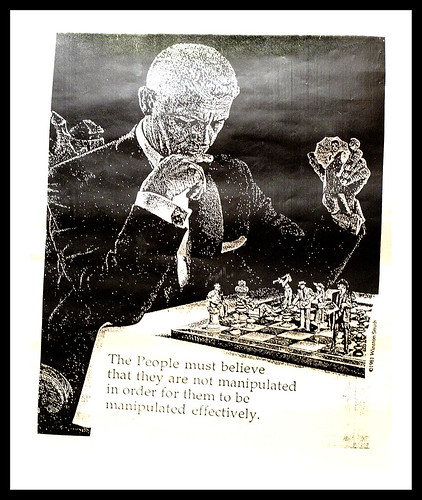
The People must believe that they are not manipulated — in order for them to be manipulated effectively. — Winston Smith, main character in George Orwell's 1984
 I am plugging this book because it is important, and it has significantly influenced my view of the world. In the book the author, Jerry Mander, delivers a skillful critique of technological culture and industrialized society. The basic thesis is that society lacks the philosophical underpinnings to be appropriately skeptical of the effects of technology - and therefore also lacks the perspective to be appropriately protective of itself (and of individuals) against the harmful effects of technology (and industrialization.) Modern industrialized society has taken the sacredness out of our social and individual relationships with the Earth. This has been detrimental to ourselves, to our societies, and to the Earth...
Somebodies and Nobodies
Overcoming the Abuse of Rank
By Robert W. Fuller
In the on-going attempts to overcome racism and sexism in North America today, we are overlooking another kind of discrimination that is no less damaging and equally unjustifiable. It is a form of injustice that everyone knows, but no one sees: discrimination based on rank. Low rank -- signifying weakness, vulnerability, and the absence of power -- marks you for abuse in much the same way that race, religion, gender, and sexual orientation have long done.
When discrimination is race-based, we call it racism; when it's gender-based, we call it sexism. By analogy, rank-based discrimination might be called "rankism." Somebodies and Nobodies explains our reluctance to confront rankism, and argues that abuse based on power differences is no more justified than abuse based on color or gender differences. It shows where analyses based on identity fall short and, using dozens of examples to illustrate the argument, traces many forms of injustice and unfairness to rankism.
Somebodies and Nobodies unmasks rankism as The Feminine Mystique unmasked sexism. It demythologizes the prevailing social consensus -- the "Somebody Mystique" -- to demonstrate the pervasiveness and corrosiveness of rankism in our personal lives and social institutions. The book introduces new language and concepts that illuminate the subtle, often dysfunctional workings of power in our social interactions. It presents rankism as the last hurdle on the long road from aristocracy to a true meritocracy, brings into focus a dignitarian revolution that is already taking shape, and offers a preview of post-rankist society.
About the Contributor
Robert Fuller taught physics at Columbia University in New York, where he co-authored the classic text Mathematics for Classical and Quantum Physics. He then served as president of Oberlin College and, subsequently, worked internationally as a 'citizen diplomat' to promote democracy in developing nations. He has four children, and lives in Berkeley, California.
Visit Contributor's Website
Zarafa (?1824-12 January 1845) was a giraffe in a menagerie in the Jardin des Plantes in Paris for 18 years in the early 1800s. She was one of the first three giraffes to be seen in Europe for over three centuries, since the Medici giraffe was sent to Lorenzo de' Medici in Florence in 1486. In her lifetime, the giraffe seems not have been given a name, but was referred to as "the giraffe". Nowadays she is known by the name Zarafa (Arabic for "charming" or "lovely one"), a name given to her by the writer Michael Alinn in his book Zarafa.
...
