Showing posts with label Martin Luther King Jr.. Show all posts
Showing posts with label Martin Luther King Jr.. Show all posts
Cultural Transformation
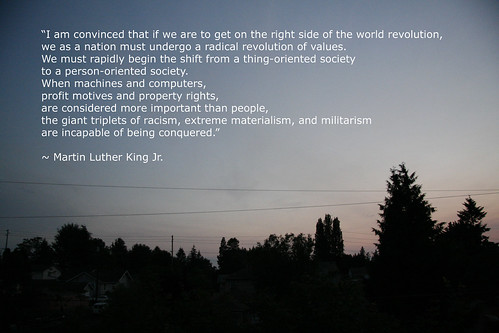
I have posted this before here, but I am posting it again, because I have been thinking about this quote recently.
Here's another MLK quote that I like:
We must accept finite disappointment,see photo larger: Cultural Transformation Shift
but we must never lose infinite hope.
– Martin Luther King Jr.
Shift
I posted this before, but here I am posting it again. I have been thinking about this quote by MLK Jr. a few times today:
"I am convinced that if we are to get on the right side of the world revolution, we as a nation must undergo a radical revolution of values. We must rapidly begin the shift from a thing-oriented society to a person-oriented society. When machines and computers, profit motives and property rights, are considered more important than people, the giant triplets of racism, extreme materialism, and militarism are incapable of being conquered."
~ Martin Luther King Jr.
"I am convinced that if we are to get on the right side of the world revolution, we as a nation must undergo a radical revolution of values. We must rapidly begin the shift from a thing-oriented society to a person-oriented society. When machines and computers, profit motives and property rights, are considered more important than people, the giant triplets of racism, extreme materialism, and militarism are incapable of being conquered."
~ Martin Luther King Jr.
Love Can Drive Out Hate

This is a re-post:
better seen large: www.flickr.com/photos/rwhitlock/3518849249/sizes/l/
"The ultimate weakness of violence
is that it is a descending spiral,
begetting the very thing it seeks to destroy.
Instead of diminishing evil, it multiplies it.
Through violence you may murder the liar,
but you cannot murder the lie, nor establish the truth.
Through violence you may murder the hater,
but you do not murder hate.
In fact, violence merely increases hate. So it goes.
Returning violence for violence multiplies violence,
adding deeper darkness to a night already devoid of stars.
Darkness cannot drive out darkness; only light can do that.
Hate cannot drive out hate: only love can do that."
— MARTIN LUTHER KING, JR.
http://inthecourseofevents.blogspot.com/2009/05/love-can-drive-out-hate-martin-luter.html
On the Right Side
"I am convinced that if we are to get on the right side of the world revolution, we as a nation must undergo a radical revolution of values. We must rapidly begin the shift from a thing-oriented society to a person-oriented society. When machines and computers, profit motives and property rights, are considered more important than people, the giant triplets of racism, extreme materialism, and militarism are incapable of being conquered."
~ Martin Luther King Jr.
Six Principles of Nonviolence from MLK
Here are six principles of nonviolence, as espoused by the great Martin Luther King Jr.. I found these principles on the New Mexico Martin Luther King Jr. State Commission website via a link from the National Fellowship of Reconciliation Blog, forpeace.net. :
SIX PRINCIPLES OF NONVIOLENCE
PRINCIPLE ONE: Nonviolence is a way of life for courageous people.
It is active nonviolent resistance to evil.
It is aggressive spirituality, mentally, and emotionally.
It is always persuading the opponent of the righteousness of your cause.
It is only passive in it’s non-aggression towards its enemy.
PRINCIPLE TWO: Nonviolence seeks to win friendship and understanding.
The end result of nonviolence is redemption and reconciliation.
The purpose of nonviolence is the creation of the Beloved Community.
PRINCIPLE THREE: Nonviolence seeks to defeat injustice not people.
Nonviolence recognized that evil doers are also victims, and are not evil people.
The nonviolent resister seeks to defeat evil, not people.
PRINCIPLE FOUR: Nonviolence holds that suffering can educate and transform.
Nonviolence accepts suffering without retaliation.
Nonviolence accepts violence if necessary, but will never inflict it.
Nonviolence willingly accepts the consequences of its acts.
Unearned suffering is redemptive, and has tremendous educational and transforming possibilities.
Suffering has the power to convert the enemy when reason fails.
PRINCIPLE FIVE: Nonviolence chooses love instead of hate.
Nonviolence resists violence of the spirit, as well as of the body.
Nonviolent love is spontaneous, unmotivated, unselfish and creative.
Nonviolent love gives willingly, knowing that the return might be hostility.
Nonviolent love is active, not passive.
Nonviolent love is un-ending in its ability to forgive - in order to restore community.
Nonviolent love does not sink to the level of the hater.
Love for the enemy is how we demonstrate love for ourselves.
Love restores community and resists injustice.
Nonviolence recognizes the fact that all life is interrelated.
PRINCIPLE SIX: Nonviolence believes that the universe is on the side of justice.
The Nonviolent resister had deep faith that justice will eventually win.
Nonviolence believes that God is a God of justice.
link to original: http://www.nmmlksc.com/sixprinciples.html
The one part of this that jumps out at me is the use of the word 'aggressive' in the first principle. I would prefer using the word assertive. Nonviolence is having an assertive spirituality, emotionality, and mentality.
SIX PRINCIPLES OF NONVIOLENCE
PRINCIPLE ONE: Nonviolence is a way of life for courageous people.
It is active nonviolent resistance to evil.
It is aggressive spirituality, mentally, and emotionally.
It is always persuading the opponent of the righteousness of your cause.
It is only passive in it’s non-aggression towards its enemy.
PRINCIPLE TWO: Nonviolence seeks to win friendship and understanding.
The end result of nonviolence is redemption and reconciliation.
The purpose of nonviolence is the creation of the Beloved Community.
PRINCIPLE THREE: Nonviolence seeks to defeat injustice not people.
Nonviolence recognized that evil doers are also victims, and are not evil people.
The nonviolent resister seeks to defeat evil, not people.
PRINCIPLE FOUR: Nonviolence holds that suffering can educate and transform.
Nonviolence accepts suffering without retaliation.
Nonviolence accepts violence if necessary, but will never inflict it.
Nonviolence willingly accepts the consequences of its acts.
Unearned suffering is redemptive, and has tremendous educational and transforming possibilities.
Suffering has the power to convert the enemy when reason fails.
PRINCIPLE FIVE: Nonviolence chooses love instead of hate.
Nonviolence resists violence of the spirit, as well as of the body.
Nonviolent love is spontaneous, unmotivated, unselfish and creative.
Nonviolent love gives willingly, knowing that the return might be hostility.
Nonviolent love is active, not passive.
Nonviolent love is un-ending in its ability to forgive - in order to restore community.
Nonviolent love does not sink to the level of the hater.
Love for the enemy is how we demonstrate love for ourselves.
Love restores community and resists injustice.
Nonviolence recognizes the fact that all life is interrelated.
PRINCIPLE SIX: Nonviolence believes that the universe is on the side of justice.
The Nonviolent resister had deep faith that justice will eventually win.
Nonviolence believes that God is a God of justice.
link to original: http://www.nmmlksc.com/sixprinciples.html
The one part of this that jumps out at me is the use of the word 'aggressive' in the first principle. I would prefer using the word assertive. Nonviolence is having an assertive spirituality, emotionality, and mentality.
Love Can Drive Out Hate | Martin Luter King Jr.
 "The ultimate weakness of violence is that it is a descending spiral, begetting the very thing it seeks to destroy.
 Instead of diminishing evil, it multiplies it.
Through violence you may murder the liar,
but you cannot murder the lie, nor establish the truth.
Through violence you may murder the hater,
but you do not murder hate.
In fact, violence merely increases hate.
So it goes.
Returning violence for violence multiplies violence,
adding deeper darkness to a night already devoid of stars.
Darkness cannot drive out darkness; only light can do that.
Hate cannot drive out hate: only love can do that."
- MARTIN LUTHER KING, JR., Where Do We Go from Here: Chaos or Community?, pp. 62–63 (1967).
see larger: Love Can Drive Out Hate
Truth Will Have Final Word in Reality
This is an excerpt from Martin Luther King Jr.'s Nobel Prize Acceptance Speech in December of 1964. I was turned onto it when read it in the program for an Olympia Family Theater production of Korczak's Children, which is about the Warsaw Ghetto in Nazi Poland.
I refuse to accept despair as the final response to the ambiguities of history. I refuse to accept the idea that the "isness" of man's present nature makes him morally incapable of reaching up for the eternal "oughtness" that forever confronts him. I refuse to accept the idea that man is mere flotsom and jetsom in the river of life unable to influence the unfolding events which surround him. I refuse to accept the view that mankind is so tragically bound to the starless midnight of racism and war that the bright daybreak of peace and brotherhood can never become a reality.
I refuse to accept the cynical notion that nation after nation must spiral down a militaristic stairway into the hell of thermonuclear destruction. I believe that unarmed truth and unconditional love will have the final word in reality. This is why right temporarily defeated is stronger than evil triumphant. I believe that even amid today's motor bursts and whining bullets, there is still hope for a brighter tomorrow. I believe that wounded justice, lying prostrate on the blood-flowing streets of our nations, can be lifted from this dust of shame to reign supreme among the children of men. I have the audacity to believe that peoples everywhere can have three meals a day for their bodies, education and culture for their minds, and dignity, equality and freedom for their spirits. I believe that what self-centered men have torn down men other-centered can build up...
Celebrate the Life and Work of Martin Luther King Jr.
MLK had a vision for a better world. His vision is no less relevant in today's America than it was in 1967. Today I will be celebrating the life and the courageous work of this civic and spiritual leader, Martin Luther King Jr..
"I am convinced that if we are to get on the right side of the world revolution, we as a nation must undergo a radical revolution of values. We must rapidly begin the shift from a thing-oriented society to a person-oriented society. When machines and computers, profit motives and property rights, are considered more important than people, the giant triplets of racism, extreme materialism, and militarism are incapable of being conquered."~ Martin Luther King Jr., From "Beyond Vietnam," an address delivered to the Clergy and Laymen Concerned about Vietnam, at Riverside Church, 4 April 1967 in New York City.
MLK RIP
The Martin Luther King You Don't See on TV
By Jeff Cohen and Norman Solomon
t r u t h o u t | Guest Contributors
Wednesday 04 April 2007
By Jeff Cohen and Norman Solomon
t r u t h o u t | Guest Contributors
Wednesday 04 April 2007
It's become a TV ritual: Every year on April 4, as Americans commemorate Martin Luther King's death, we get perfunctory network news reports about "the slain civil rights leader."link to original
The remarkable thing about these reviews of King's life is that several years - his last years - are totally missing, as if flushed down a memory hole.
What TV viewers see is a closed loop of familiar file footage: King battling segregation in Birmingham (1963); reciting his dream of racial harmony at the rally in Washington (1963); marching for voting rights in Selma, Alabama (1965); and finally, lying dead on the motel balcony in Memphis (1968).
An alert viewer might notice that the chronology jumps from 1965 to 1968. Yet King didn't take a sabbatical near the end of his life. In fact, he was speaking and organizing as diligently as ever.
Almost all of those speeches were filmed or taped. But they're not shown today on TV.
Why?
It's because national news media have never come to terms with what Martin Luther King Jr. stood for during his final years.
In the early 1960s, when King focused his challenge on legalized racial discrimination in the South, most major media were his allies. Network TV and national publications graphically showed the police dogs and bullwhips and cattle prods used against Southern blacks who sought the right to vote or [the right] to eat at a public lunch counter.
But after passage of civil rights acts in 1964 and 1965, King began challenging the nation's fundamental priorities. He maintained that civil rights laws were empty without "human rights" - including economic rights. For people too poor to eat at a restaurant or afford a decent home, King said, anti-discrimination laws were hollow.
Noting that a majority of Americans below the poverty line were white, King developed a class perspective. He decried the huge income gaps between rich and poor, and called for "radical changes in the structure of our society" to redistribute wealth and power.
...
Nonviolence is the Way
If you succumb to the temptation of using violence in the struggle ... your chief legacy to the future will be an endless reign of meaningless chaos.– Martin Luther King, Jr.
Question of Conscience
“Cowardice asks the question, ‘Is it safe?’ Expediency asks the question, ‘Is it politic?’ Vanity asks the question, ‘Is is popular?’ But, conscience asks the question, ‘Is it right?’ and there comes a time when one must take a position that is neither safe, nor politic, nor popular, but one must take it because one’s conscience tells one that it is right.”
- Dr. Martin Luther King Jr.
- Dr. Martin Luther King Jr.
Dr. Martin Luther King Jr. Day Civil Disobedience

link to photos
Activists hung a banner from a highway overpass near the maingate of the Bangor Naval Submarine Base. The Banner contains a message from Dr. MLK Jr.: "When scientific power outruns spiritual power, we end up with guided missiles and misguided men." The nonviolent direct action to obstruct entrance to the submarine base was coordinated by the Ground Zero Center for Nonviolent Action in celebration of Dr. King's life, work and birthday. He would have been 78 years old on Monday.
Subscribe to:
Posts (Atom)